Before any symbol is used, here is the vocabulary, each anchored to a picture you'll meet below.
See Surface Chemistry & Adsorption for the Langmuir kinetics that birth θ(t)=1−e−kPt, and the Hinglish parent if you want the plain-language story first. Everything here deepens 4.3.14 Atomic layer deposition (ALD) (Hinglish)'s parent — never contradicts it.
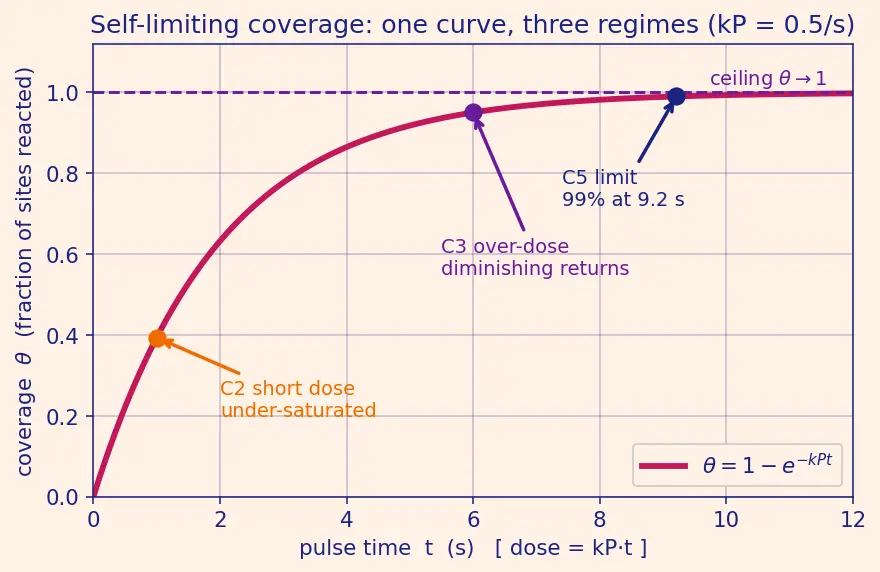
Every ALD numeric question falls into one of these cells. Each example below is tagged with the cell it covers.
| Cell |
What makes it distinct |
Example |
| C1 Thickness ↔ cycles |
plain d=GPC×N, both directions |
Ex 1 |
| C2 Short dose (under-saturation) |
small kPt, film NOT saturated |
Ex 2 |
| C3 Long dose (over-dose) |
large kPt, diminishing returns |
Ex 3 |
| C4 Zero / degenerate input |
t=0, P=0, N=0 — nothing happens |
Ex 4 |
| C5 Limiting behaviour |
t→∞ ceiling; % to reach 99% |
Ex 5 |
| C6 Sub-monolayer + steric |
GPC < one monolayer, ligand blocking |
Ex 6 |
| C7 Word problem: deep trench |
conformality, diffusion time to bottom |
Ex 7 |
| C8 Exam twist: temperature/decomposition |
outside the ALD window, law breaks |
Ex 8 |
Recall Which cell is which? (click to reveal)
"8 nm needs how many cycles?" ::: C1 — plain thickness↔cycles.
"θ after a 1 s pulse, kP=0.4?" ::: C2 — short dose / under-saturation.
"Time to reach 99% coverage?" ::: C5 — limiting behaviour, invert with ln.
"Does the trench bottom saturate?" ::: C7 — conformality word problem.
"GPC jumped to 6 Å/cycle at 400 °C?" ::: C8 — outside the ALD window (CVD mode).
