Every spin problem you'll meet lives in one of these cells. The examples below are labelled with the cell they cover.
| Cell |
What makes it different |
Covered by |
| A. Magnitude, any s |
depends on s(s+1) only, never on ms |
Ex 1 |
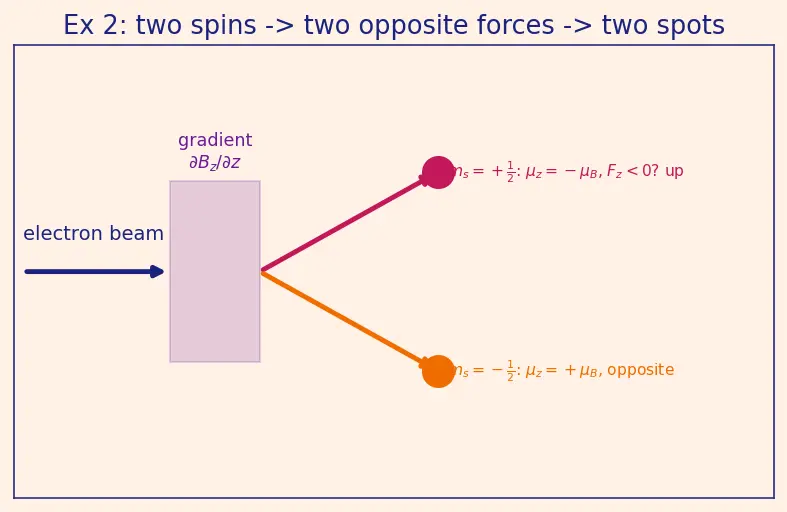
| B. Projection, ms>0 (spin up) |
positive Sz, force one way |
Ex 2 |
| C. Projection, ms<0 (spin down) |
negative Sz, force the other way |
Ex 2, Ex 5 |
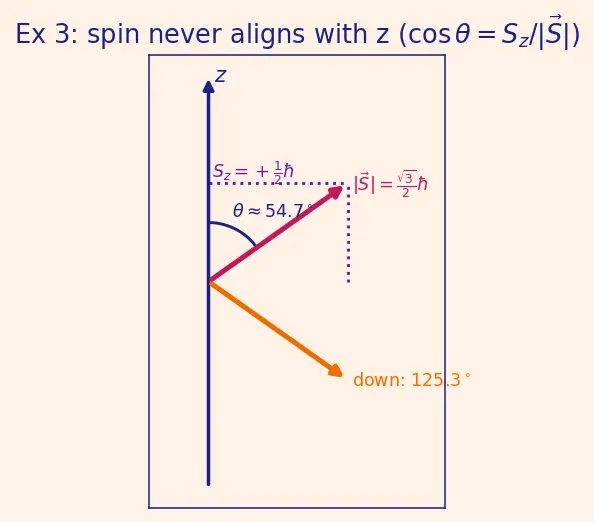
| D. Tilt angle from z |
why θ=0 ever; all allowed θ |
Ex 3 |
| E. Degenerate input s=0 |
zero magnitude, one spot, no splitting |
Ex 4 |
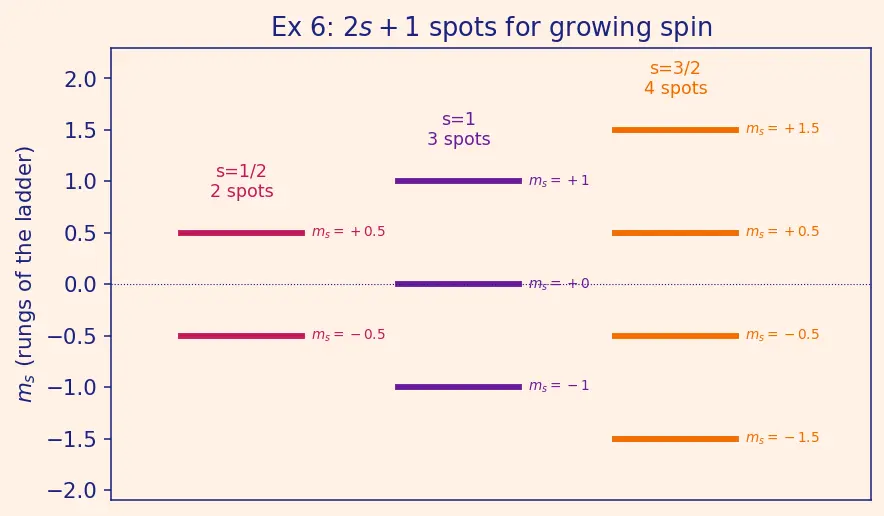
| F. Bigger ladder s=1, s=23 |
2s+1 spots, all ms steps |
Ex 6 |
| G. Limiting / classical check |
"spinning ball" would break light-speed |
Ex 7 |
| H. Real-world word problem |
Stern–Gerlach with actual numbers/units |
Ex 8 |
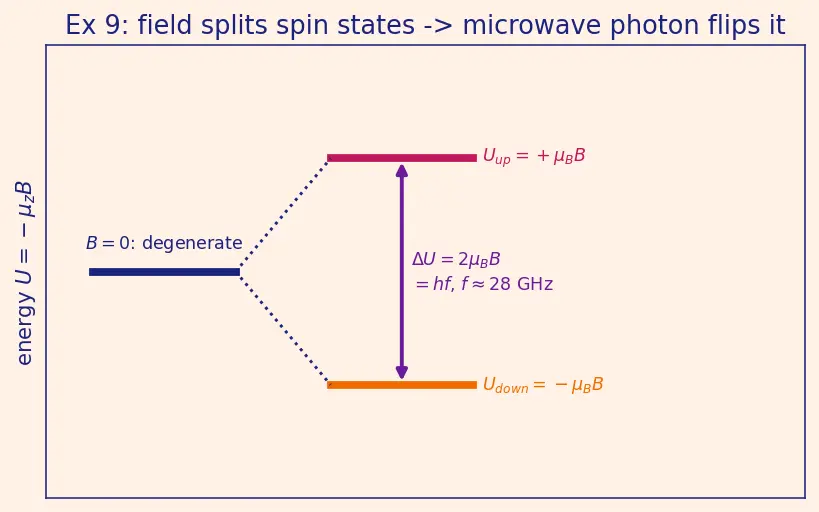
| I. Exam-style twist |
energy splitting U=−μzB, spin-flip photon |
Ex 9 |
We use these constants throughout (memorise the symbols, not the digits):
The vector S can never lie flat along z. Here is why, and all the angles it is allowed to make.
- Parent: Spin — intrinsic angular momentum
- Stern-Gerlach Experiment — Ex 2, 4, 8 are its arithmetic.
- Orbital Angular Momentum — same ℓ(ℓ+1) magnitude rule, integer only.
- Quantum Numbers — where ms sits in the full state label.
- Bohr Magneton — the unit doing the work in Ex 8, 9.
- Zeeman Effect & Fine Structure — Ex 9's energy splitting.
- Pauli Exclusion Principle — needs the two ms of Ex 2.
- Dirac Equation — the source of gs≈2 used everywhere above.


