The error bound (from the parent note):
∣Rn(x)∣≤(n+1)!M∣x−a∣n+1,M=maxt between a,xf(n+1)(t).
Read it as "Next derivative, Next factorial, Next power" — everything is n+1, one step beyond the polynomial degree n.
Here you just read the formula and name the pieces. No calculus yet.
Recall Solution L1.1
WHAT the symbols mean.n is the degree of the polynomial you kept. The bound always uses one step beyondn.
Derivative needed: f(n+1)=f(5) — the fifth derivative.
Factorial: (n+1)!=5!=120.
Power: ∣x−a∣5.
WHY n+1 and not n. The polynomial P4 already matches f up to the 4th derivative; the first thing it gets wrong is the 5th derivative term, so that is what controls the leftover error.
Recall Solution L1.2
Derivatives at 0: f(0)=cos0=1, f′(0)=−sin0=0, f′′(0)=−cos0=−1.
P2(x)=1+0⋅x−21x2=1−2x2.R2(x)=cosx−(1−2x2) — the exact gap between the true cosine and this parabola.
Now plug numbers into the recipe: find M, compute the bound.
Recall Solution L2.1
f(x)=ex, a=0, n=2, x=0.2.
f(3)(t)=et. On [0,0.2] it is increasing, biggest at t=0.2: e0.2≈1.221<1.5. Take M=1.5.
Why an over-estimate? We want a safe upper bound; picking M a little large only makes the guaranteed error a little large, never wrong.
∣R2(0.2)∣≤3!1.5(0.2)3=61.5(0.008)=0.002.
So P2(0.2)=1.22 is correct to within 0.002. (True e0.2=1.22140…, actual error ≈0.00140 — inside the bound. ✓)
Recall Solution L2.2
f(x)=sinx, a=0, n=3.
f(4)(t)=sint, and ∣sint∣≤1 always, so M=1 (no interval work needed — the cleanest possible bound).
∣R3(0.5)∣≤4!1(0.5)4=240.0625≈2.60×10−3.P3(0.5)=0.5−0.020833=0.479167; true sin0.5=0.479426, actual error ≈2.6×10⁻⁴. ✓
We need M=max∣f′′′(t)∣ on [0,0.3]. Since 2(1+t)−3decreases as t grows, its max is at t=0: M=2(1)−3=2.
Why the left endpoint?(1+t)−3 shrinks when t rises, so the worst (largest) case is the smallest t.
∣R2(0.3)∣≤3!2(0.3)3=62(0.027)=0.009.
Recall Solution L2.4
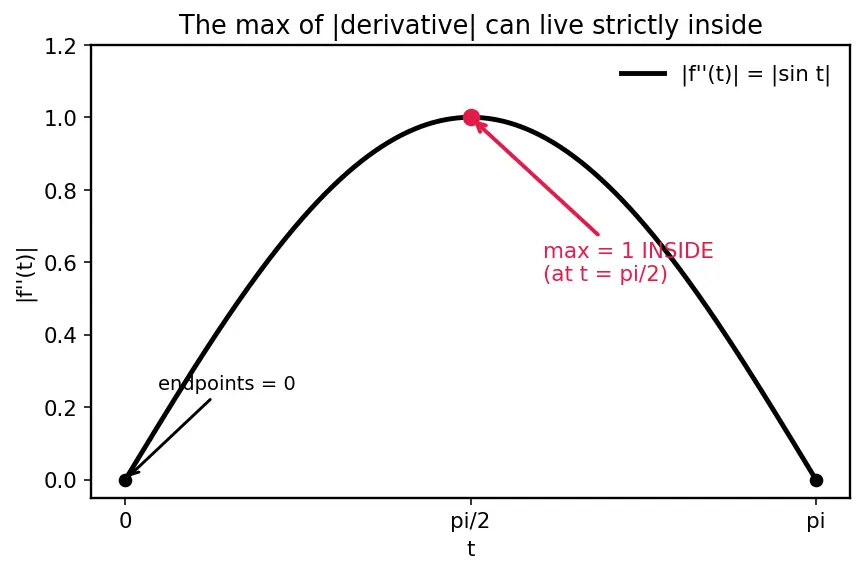
n=1, so we need f(2)(t)=−sint, giving ∣f(2)(t)∣=∣sint∣ on [0,π].
WHERE is the max?∣sint∣ is zero at both endpoints (sin0=0, sinπ=0) and rises to 1 at the interior point t=π/2. So the maximum is strictly inside — M=1 at t=π/2, not at an endpoint. Look at the figure: the peak (red dot) sits in the middle, not at the edges.
Why endpoints would fail here: plugging t=0 or t=π gives ∣f(2)∣=0, which would falsely claim zero error — clearly wrong, since sinπ=0 but P1(π)=π=0.
∣R1(π)∣≤2!1∣π−0∣2=2π2≈4.93.
A large but honest bound: the linear approximation is genuinely terrible that far out, and only the interior maximum captures it.
Now solve for an unknown: how many terms? how close must x be?
Recall Solution L3.1
f(x)=ex, a=0, x=0.5. On [0,0.5], f(n+1)(t)=et≤e0.5<2, so M=2.
∣Rn(0.5)∣≤(n+1)!2(0.5)n+1.
Demand <10−5. Test values:
n=4: 5!2(0.5)5=1202(0.03125)=5.2×10⁻⁴ — too big.
n=5: 6!2(0.5)6=7202(0.015625)=4.34×10⁻⁵ — still too big.
n=6: 7!2(0.5)7=50402(0.0078125)=3.10×10⁻⁶<10−5. ✓
Answer: n=6 (terms up to x6/6!).
Note how the small factor (0.5)n+1 helps you — far fewer terms than the x=1 case in the parent note.
Recall Solution L3.2
f(5)(t)=sint (up to sign), so M=1.
∣R4(x)∣≤5!1∣x∣5=120∣x∣5≤10−3.Solve for ∣x∣. Multiply both sides by 120: ∣x∣5≤0.12.
Now take the fifth root of both sides — why is that legal? The function u↦u1/5 is increasing for u≥0, so it preserves the inequality direction; and ∣x∣≥0, so its fifth root is well defined. Hence
∣x∣≤0.121/5.
Compute: 0.121/5=e(ln0.12)/5=e−0.4241≈0.6544.
Answer: ∣x∣≲0.654 guarantees 10−3 accuracy. (Because the bound uses ∣x∣, this range is symmetric: it works for x=+0.6andx=−0.6 — see L4.3.)
Now combine ideas — non-zero centre, negative targets, choosing the smart centre.
Recall Solution L4.1
Here x=0.5 and a=0.5, so x−a=0. Every Taylor polynomial gives Pn(0.5)=f(0.5)exactly.
∣R1(0.5)∣≤2!M∣0.5−0.5∣2=2M⋅0=0.Zero error — because ∣x−a∣n+1=0. This is the degenerate/limiting case: the closer your centre is to the target, the smaller ∣x−a∣ and the more brutally the power ∣x−a∣n+1 crushes the error. It is the whole reason Taylor approximations are "local."
Recall Solution L4.2
a=1, x=1.5, so x−a=0.5, n=3. Derivatives of lnx:
f′=x−1, f′′=−x−2, f′′′=2x−3, f(4)=−6x−4.
M=max[1,1.5]∣−6x−4∣=6x−4. This decreases in x, so max at x=1: M=6.
Why x=1?x−4 shrinks as x grows, so the largest value is at the left endpoint.
∣R3(1.5)∣≤4!6(0.5)4=246(0.0625)=0.015625.
(For reference P3(x)=(x−1)−2(x−1)2+3(x−1)3, giving P3(1.5)=0.5−0.125+0.0416=0.416; true ln1.5=0.405465, actual error ≈0.0112<0.0156. ✓)
Recall Solution L4.3
f(x)=ex, a=0, n=2, target x=−0.4. The interval "between a and x" is now [−0.4,0] — it runs to the left of the centre.
WHAT M is here.f(3)(t)=et on [−0.4,0] is increasing, so its max is at the right end t=0: e0=1. Take M=1.
Why the right end this time?et grows with t, and t=0 is the largest t in [−0.4,0] — the mirror image of the L2.1 reasoning.
WHY the sign disappears. The bound uses ∣x−a∣n+1=∣−0.4−0∣3=∣−0.4∣3=(0.4)3. The absolute value erases the sign — a target 0.4 units to the left gives the exact same power as 0.4 units to the right. That is why we never worry about which side of the centre we are on.
∣R2(−0.4)∣≤3!1(0.4)3=60.064≈1.067×10⁻².
Check: P2(−0.4)=1−0.4+0.08=0.68; true e−0.4=0.670320, actual error ≈0.00968<0.01067. ✓
Recall Solution L4.4
From the parent note: on [0,1], f(n+1)(t)=et≤e<3, so M=3 and
∣Rn(1)∣≤(n+1)!3<10−6⟹(n+1)!>3×10⁶.
Since 9!=362880<3×10⁶ but 10!=3628800>3×10⁶, we need n+1=10, i.e. n=9 (terms up to x9/9!).
The wrong alternative, stated plainly. The exact Lagrange form is R9(1)=10!ec⋅110 for some unknownc∈(0,1). A tempting shortcut is to guess a specific value of c — say c=0, giving e0=1 and error ≈10!1 — and call that "the error."
Why it is wrong: the theorem only promises that somec exists; it never tells you which one. If the true c is closer to 1, the real factor ec is up to e≈2.718, nearly 3× your guess — so a guessed c can under-report the error and break your guarantee.
Why the bound wins: replacing ec by its safe maximum M=3 over the whole interval gives a value that is valid no matter where c hides. You trade a slightly larger (but certified) number for a promise that can never be violated.
Now prove and reason at the edge — bounds that must hold for alln, and comparisons.
Recall Solution L5.1
Every derivative of sinx is ±sin or ±cos, so ∣f(n+1)(t)∣≤1 for allt and all n. Hence M=1 works uniformly:
∣Rn(x)∣≤(n+1)!1∣x∣n+1.WHY this →0. Fix any real x. The quantity (n+1)!∣x∣n+1 is the general term of the convergent series ∑k!∣x∣k=e∣x∣; terms of a convergent series must tend to 0. Therefore ∣Rn(x)∣→0 for every x.
Conclusion: the factorial always beats the power, no matter how big ∣x∣ is — the series converges everywhere (infinite radius of convergence). ■
Recall Solution L5.2
Lagrange (from our formula), n=3:∣R3(1)∣≤4!M∣1∣4=241≈0.0417 (using M=1).
Alternating Series bound: the Maclaurin series sin1=1−3!1+5!1−⋯ is alternating with decreasing terms, so the error after the x3 term is at most the first omitted term5!1=1201≈0.00833.
Which is tighter: the alternating bound 0.00833 is about 5× smaller than 0.0417.
WHY. The Lagrange bound uses the worst-case derivative M=1 blindly; the alternating theorem exploits the cancellation between + and − terms, which is extra information. When a series alternates, prefer that theorem; when it does not, Lagrange is your general tool.
Recall Solution L5.3
Exact Lagrange form: Rn(x)=(n+1)!ecxn+1 for some c between 0 and x.
As x→0, that c→0 too, so ec→1. Thus
Rn(x)=(n+1)!ecxn+1=tends to a constant(n+1)!1+o(1)xn+1.
The dominant behaviour is xn+1 times a bounded factor, which is exactly the meaning of Rn(x)=O(xn+1): the error shrinks like the next power of x as x→0. The factor (n+1)!1 is the leading constant hidden inside the Big-O.
L1 = you can name the pieces; L2 = you can compute a bound (including when the max is interior); L3 = you can solve for n or the range; L4 = you handle shifted centres, negative targets, and the ∣x−a∣n+1 factor; L5 = you can prove convergence and compare bounds.