Error bound (parent note se):
∣Rn(x)∣≤(n+1)!M∣x−a∣n+1,M=maxt between a,xf(n+1)(t).
Ise aise padhein: "Next derivative, Next factorial, Next power" — sab kuch n+1 hai, polynomial degree n se ek kadam aage.
Yeh bound Lagrange form Rn=(n+1)!f(n+1)(c)(x−a)n+1 se aata hai, jahan c unknown hai, isliye hum f(n+1)(c) ko uske worst-case size M se replace kar dete hain.
n+1 kyun aur n kyun nahi. Polynomial P4 pehle se hi f se 4th derivative tak match karti hai; pehli cheez jo woh galat karti hai woh 5th derivative term hai, isliye wahi leftover error ko control karti hai.
Recall Solution L1.2
0 par derivatives: f(0)=cos0=1, f′(0)=−sin0=0, f′′(0)=−cos0=−1.
P2(x)=1+0⋅x−21x2=1−2x2.R2(x)=cosx−(1−2x2) — true cosine aur is parabola ke beech ka exact gap.
Hume M=max∣f′′′(t)∣ chahiye [0,0.3] par. Kyunki 2(1+t)−3decrease karta hai jab t badhta hai, uska max t=0 par hai: M=2(1)−3=2.
Left endpoint kyun?(1+t)−3 shrink hota hai jab t badhta hai, isliye worst (largest) case sabse chhote t par hai.
∣R2(0.3)∣≤3!2(0.3)3=62(0.027)=0.009.
Recall Solution L2.4
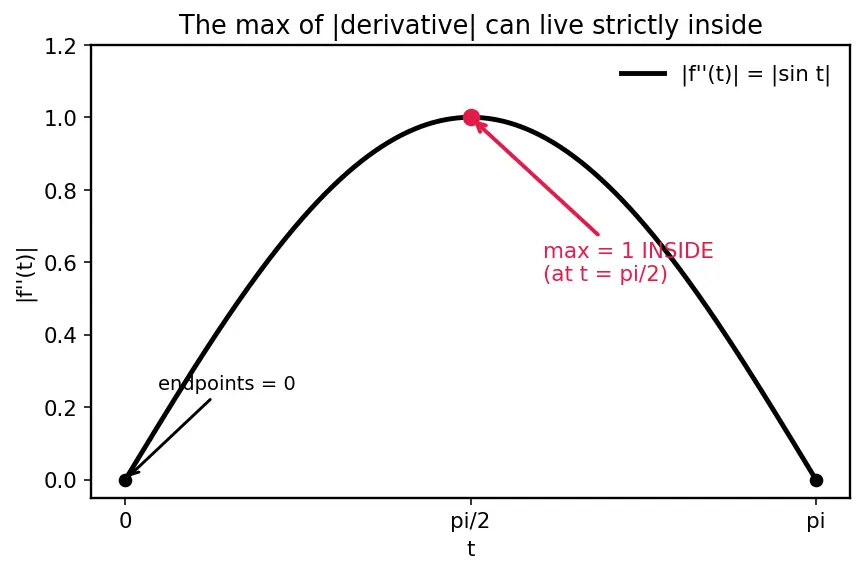
n=1, toh hume f(2)(t)=−sint chahiye, jo deta hai ∣f(2)(t)∣=∣sint∣[0,π] par.
Max KAHAAN hai?∣sint∣dono endpoints par zero hai (sin0=0, sinπ=0) aur interior point t=π/2 par 1 tak utha hua hai. Toh maximum strictly inside hai — M=1t=π/2 par, kisi endpoint par nahi. Figure dekhein: peak (red dot) beech mein baithti hai, edges par nahi.
Yahan endpoints fail kyun hote:t=0 ya t=π plug karne se ∣f(2)∣=0 milta hai, jo falsely zero error claim karta — clearly galat, kyunki sinπ=0 hai lekin P1(π)=π=0.
∣R1(π)∣≤2!1∣π−0∣2=2π2≈4.93.
Ek bada lekin honest bound: itni door linear approximation genuinely terrible hai, aur sirf interior maximum ise capture karta hai.
Ab unknown ke liye solve karein: kitne terms? x kitna close hona chahiye?
Recall Solution L3.1
f(x)=ex, a=0, x=0.5. [0,0.5] par, f(n+1)(t)=et≤e0.5<2, isliye M=2.
∣Rn(0.5)∣≤(n+1)!2(0.5)n+1.<10−5 ki demand karein. Values test karein:
n=4: 5!2(0.5)5=1202(0.03125)=5.2×10⁻⁴ — bahut bada.
n=5: 6!2(0.5)6=7202(0.015625)=4.34×10⁻⁵ — abhi bhi bahut bada.
n=6: 7!2(0.5)7=50402(0.0078125)=3.10×10⁻⁶<10−5. ✓
Answer: n=6 (x6/6! tak terms).
Note karo ki chhota factor (0.5)n+1 aapki help karta hai — parent note ke x=1 case se kaafi kam terms.
Recall Solution L3.2
f(5)(t)=sint (sign tak), toh M=1.
∣R4(x)∣≤5!1∣x∣5=120∣x∣5≤10−3.∣x∣ ke liye solve karein. Dono sides ko 120 se multiply karein: ∣x∣5≤0.12.
Ab dono sides ki fifth root lein — yeh legal kyun hai? Function u↦u1/5u≥0 ke liye increasing hai, isliye yeh inequality direction preserve karta hai; aur ∣x∣≥0, toh uski fifth root well defined hai. Hence
∣x∣≤0.121/5.
Compute karein: 0.121/5=e(ln0.12)/5=e−0.4241≈0.6544.
Answer: ∣x∣≲0.65410−3 accuracy guarantee karta hai. (Kyunki bound ∣x∣ use karta hai, yeh range symmetric hai: x=+0.6aurx=−0.6 dono ke liye kaam karta hai — dekho L4.3.)
Ab ideas combine karein — non-zero centre, negative targets, smart centre choose karna.
Recall Solution L4.1
Yahan x=0.5 aur a=0.5, isliye x−a=0. Har Taylor polynomial Pn(0.5)=f(0.5)exactly deta hai.
∣R1(0.5)∣≤2!M∣0.5−0.5∣2=2M⋅0=0.Zero error — kyunki ∣x−a∣n+1=0. Yeh degenerate/limiting case hai: aapका centre target ke jitna close hoga, ∣x−a∣ utna chhota hoga aur power ∣x−a∣n+1 error ko utni brutally crush karegi. Yahi poora reason hai ki Taylor approximations "local" hoti hain.
M=max[1,1.5]∣−6x−4∣=6x−4. Yeh x mein decrease karta hai, isliye max x=1 par: M=6.
x=1 kyun?x−4 shrink hota hai jab x badhta hai, isliye sabse badi value left endpoint par hai.
∣R3(1.5)∣≤4!6(0.5)4=246(0.0625)=0.015625.
(Reference ke liye P3(x)=(x−1)−2(x−1)2+3(x−1)3, deta hai P3(1.5)=0.5−0.125+0.0416=0.416; true ln1.5=0.405465, actual error ≈0.0112<0.0156. ✓)
Recall Solution L4.3
f(x)=ex, a=0, n=2, target x=−0.4. "Between a and x" interval ab [−0.4,0] hai — yeh centre ke left ki taraf jaata hai.
Yahan M kya hai.f(3)(t)=et[−0.4,0] par increasing hai, isliye uska max right end t=0 par hai: e0=1. M=1 lein.
Is baar right end kyun?ett ke saath badhta hai, aur t=0[−0.4,0] mein sabse bada t hai — L2.1 reasoning ka mirror image.
Sign kyun disappear hoti hai. Bound ∣x−a∣n+1=∣−0.4−0∣3=∣−0.4∣3=(0.4)3 use karta hai. Absolute value sign mita deta hai — 0.4 units left par ek target wahi power deta hai jo 0.4 units right par. Isliye hum kabhi worry nahi karte ki centre ke kis side par hain.
∣R2(−0.4)∣≤3!1(0.4)3=60.064≈1.067×10⁻².
Check: P2(−0.4)=1−0.4+0.08=0.68; true e−0.4=0.670320, actual error ≈0.00968<0.01067. ✓
Recall Solution L4.4
Parent note se: [0,1] par, f(n+1)(t)=et≤e<3, toh M=3 aur
∣Rn(1)∣≤(n+1)!3<10−6⟹(n+1)!>3×10⁶.
Kyunki 9!=362880<3×10⁶ lekin 10!=3628800>3×10⁶, hume n+1=10 chahiye, yaani n=9 (x9/9! tak terms).
Galat alternative, clearly stated. Exact Lagrange form hai R9(1)=10!ec⋅110 kisi unknown c∈(0,1) ke liye. Ek tempting shortcut yeh hai ki c ki ek specific value guess karein — say c=0, jo e0=1 aur error ≈10!1 deta hai — aur use "the error" bulayein.
Kyun galat hai: theorem sirf promise karta hai ki koic exist karta hai; woh kabhi nahi batata kaun sa. Agar true c1 ke closer hai, toh real factor ec up to e≈2.718 ho sakta hai, aapke guess se lagbhag 3× zyada — toh guessed c error ko under-report kar sakta hai aur aapki guarantee tod sakta hai.
Bound kyun jeetta hai:ec ko pure interval par uske safe maximum M=3 se replace karna ek aisi value deta hai jo valid hai chahe c kahaan bhi chhupa ho. Aap thodi badi (lekin certified) number ke liye ek aisa vaada trade karte hain jo kabhi violate nahi ho sakta.
Ab prove karein aur edge par reason karein — bounds jo saaren ke liye hold karni chahiye, aur comparisons.
Recall Solution L5.1
sinx ki har derivative ±sin ya ±cos hai, isliye ∣f(n+1)(t)∣≤1saaret aur saare n ke liye. Hence M=1 uniformly kaam karta hai:
∣Rn(x)∣≤(n+1)!1∣x∣n+1.YEH →0 kyun hai. Koi bhi real x fix karein. Quantity (n+1)!∣x∣n+1 convergent series ∑k!∣x∣k=e∣x∣ ka general term hai; ek convergent series ke terms 0 ki taraf tend karne chahiye. Isliye ∣Rn(x)∣→0 har x ke liye.
Conclusion: factorial hamesha power ko beat karta hai, chahe ∣x∣ kitna bhi bada ho — series everywhere converge hoti hai (infinite radius of convergence). ■
Recall Solution L5.2
Lagrange (hamare formula se), n=3:∣R3(1)∣≤4!M∣1∣4=241≈0.0417 (M=1 use karte hue).
Alternating Series bound: Maclaurin series sin1=1−3!1+5!1−⋯ alternating hai decreasing terms ke saath, isliye x3 term ke baad error at most first omitted term5!1=1201≈0.00833 hai.
Kaun tighter hai: alternating bound 0.00833 lagbhag 5× chhota hai 0.0417 se.
Kyun. Lagrange bound blindly worst-case derivative M=1 use karta hai; alternating theorem + aur − terms ke beech cancellation exploit karta hai, jo extra information hai. Jab koi series alternate karti hai, woh theorem prefer karein; jab nahi karti, Lagrange aapka general tool hai.
Recall Solution L5.3
Exact Lagrange form: Rn(x)=(n+1)!ecxn+1 kisi c ke liye 0 aur x ke beech.
Jab x→0, woh c→0 bhi, toh ec→1. Thus
Rn(x)=(n+1)!ecxn+1=ek constant ki taraf tend karta hai(n+1)!1+o(1)xn+1.
Dominant behaviour xn+1 times ek bounded factor hai, jo exactly Rn(x)=O(xn+1) ka meaning hai: error next power of x ki tarah shrink karta hai jab x→0. Factor (n+1)!1 woh leading constant hai jo Big-O ke andar chhupa hai.
L1 = aap pieces ko naam de sakte hain; L2 = aap ek bound compute kar sakte hain (including jab max interior ho); L3 = aap n ya range ke liye solve kar sakte hain; L4 = aap shifted centres, negative targets, aur ∣x−a∣n+1 factor handle karte hain; L5 = aap convergence prove kar sakte hain aur bounds compare kar sakte hain.