We reuse exactly two tools from the parent. Let us re-state them in plain words so nothing is assumed.
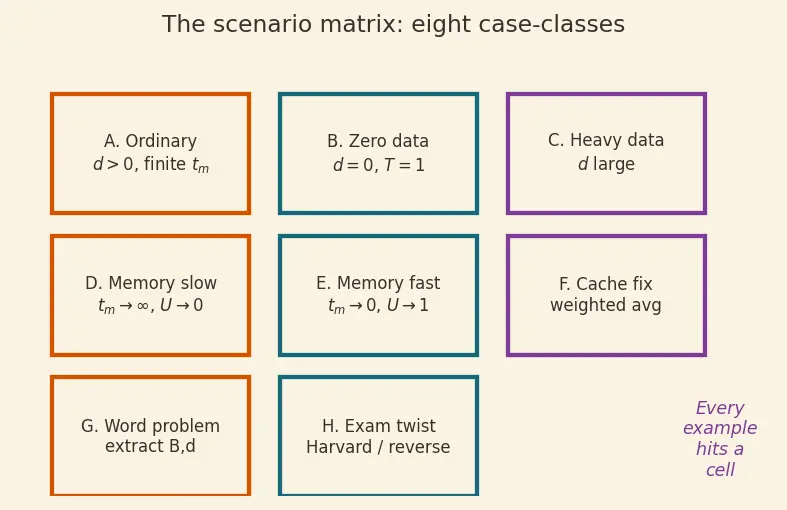
Every problem this topic can pose is one (or a blend) of these cells. Each worked example below is tagged with the cell it covers.
| Cell |
What makes it special |
Where it bites |
| A. Ordinary |
Plain numbers, d>0, finite tm |
Engine 1 & 2 straight up |
| B. Zero data (d=0) |
Instruction touches no operands (e.g. NOP, register-only op) |
T=1, pure fetch limit |
| C. Heavy data (d large) |
Instruction is mostly memory traffic |
fetch term becomes negligible |
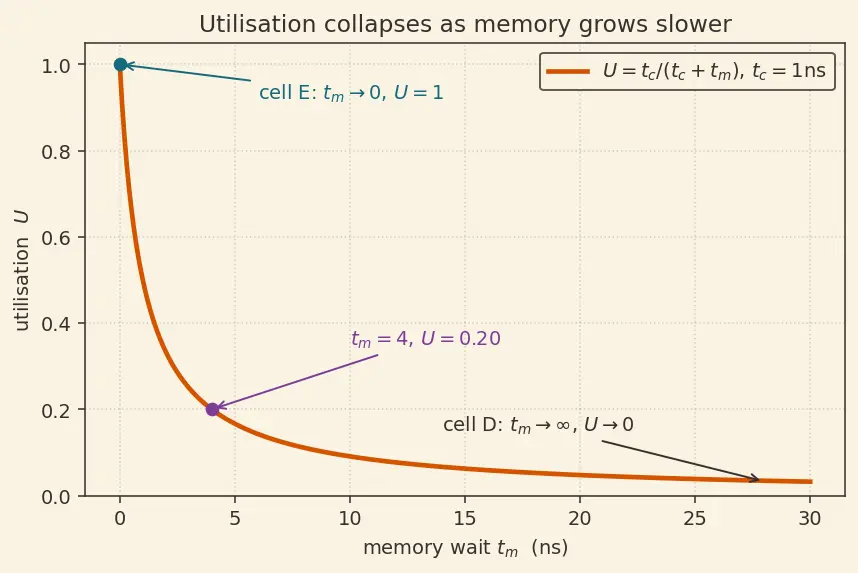
| D. Degenerate memory (tm→∞) |
Memory infinitely slow vs CPU |
U→0 — the bottleneck in the limit |
| E. Degenerate CPU (tm→0) |
Memory instant / perfect cache |
U→1 — bottleneck vanishes |
| F. Cache fix |
Weighted hit/miss average access |
Engine "bonus" |
| G. Word problem |
Real story, you must extract B,d,tc,tm |
translation skill |
| H. Exam twist |
Compare Von Neumann vs Harvard, or solve backwards for a target |
multi-step reasoning |
The nine examples below fill all eight cells (A–H), with A and H visited twice.