Before anything: the one formula this whole page turns, stated in plain words.
See Atom Economy and Yield for the yield-vs-AE distinction and E-factor and Process Mass Intensity for the waste-side twin measure.
Every AE problem you will ever meet falls into one of these cells. Each row is a case class; the last column names the worked example that covers it.
| # |
Case class |
What makes it special |
Covered by |
| 1 |
Addition (combine, nothing ejected) |
AE hits the maximum, 100% |
Example 1 |
| 2 |
Substitution (an atom is kicked out) |
AE drops — byproduct carries mass away |
Example 2 |
| 3 |
Elimination / decomposition (ONE reactant → several products) |
Degenerate: ∑Mreactants is a single molecule |
Example 3 |
| 4 |
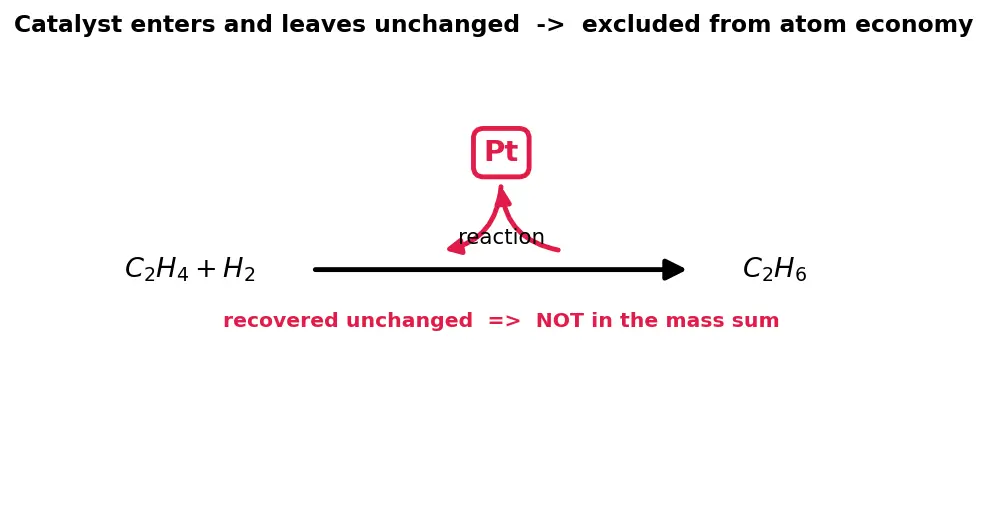
Catalytic reaction |
The catalyst must be excluded from the sum — the trap |
Example 4 |
| 5 |
Stoichiometric coefficients >1 |
Must multiply molar masses by coefficients |
Example 5 |
| 6 |
Two competing routes to the SAME product |
Compare AE to choose the greener route |
Example 6 |
| 7 |
Real-world word problem (mass given, not moles) |
Translate grams → the same formula still works |
Example 7 |
| 8 |
Limiting / extreme values (AE → 0 and AE → 100) |
Sanity-check the boundaries of the formula |
Example 8 |
Two edge behaviours worth stating up front, because they bound every answer:
- Green Chemistry & Sustainability (parent)
- Atom Economy and Yield — the yield-vs-AE contrast underpinning every cell
- E-factor and Process Mass Intensity — the waste-side twin of these numbers
- Catalysis — Example 4's exclusion rule
- Renewable Feedstocks and Biomass — Principle 7 context
- Solvent Selection and Supercritical CO2 — Principle 5 context
- Activation Energy and Reaction Rates — why catalytic routes (Ex 4, 6) run milder
