Before we start, one habit we will repeat like a mantra. To decide aromaticity we always answer four small questions in order:
Here n=0,1,2,3,…, so 4n+2=2,6,10,14,… and 4n=4,8,12,….
Every ring you can be asked about falls into one of these cells. The examples below are labelled by cell.
| Cell |
Case class |
A molecule that lives here |
| A |
Plain all-carbon, 4n+2 |
Benzene |
| B |
Plain all-carbon, 4n (would-be antiaromatic) |
Cyclobutadiene |
| C |
Escapes planarity (degenerate: ring too floppy) |
Cyclooctatetraene |
| D |
Charge removes electrons → aromatic cation |
Tropylium C7H7+ |
| E |
Charge adds electrons into a p-orbital → aromatic anion |
Cyclopentadienyl anion |
| F |
Heteroatom lone pair in the π system |
Pyrrole / furan |
| G |
Heteroatom lone pair in-plane, not counted |
Pyridine |
| H |
n=0 edge case (smallest possible, only 2 π e⁻) |
Cyclopropenyl cation |
| I |
Fused polycyclic — apply rule to perimeter |
Naphthalene |
| J |
Word-problem / reactivity twist (why acidity, why no Br₂ test) |
Cyclopentadiene acidity |
We will now walk A → J. Keep the checklist beside you.
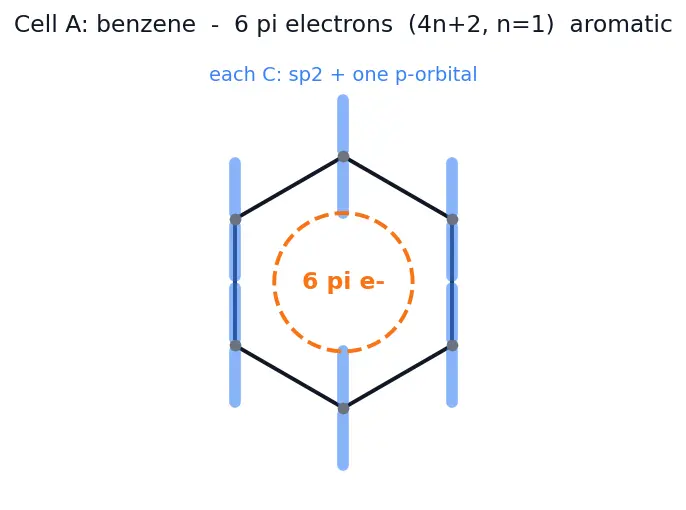
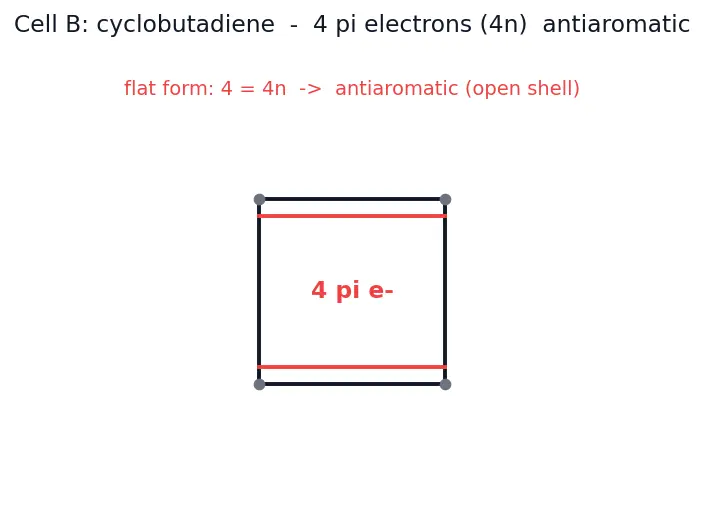
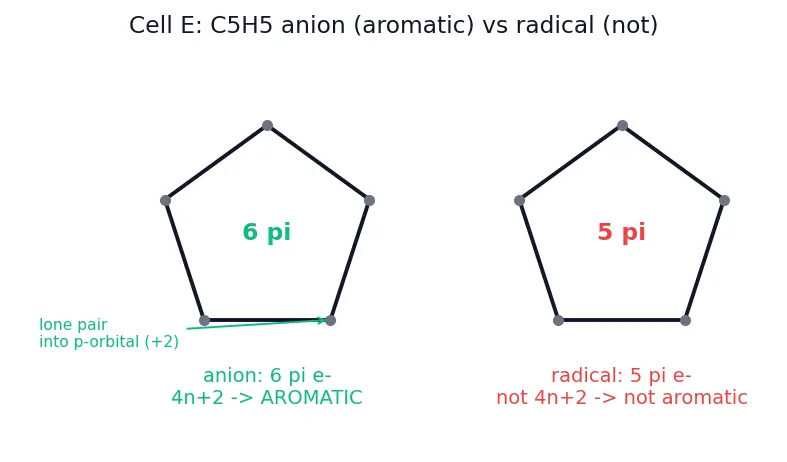
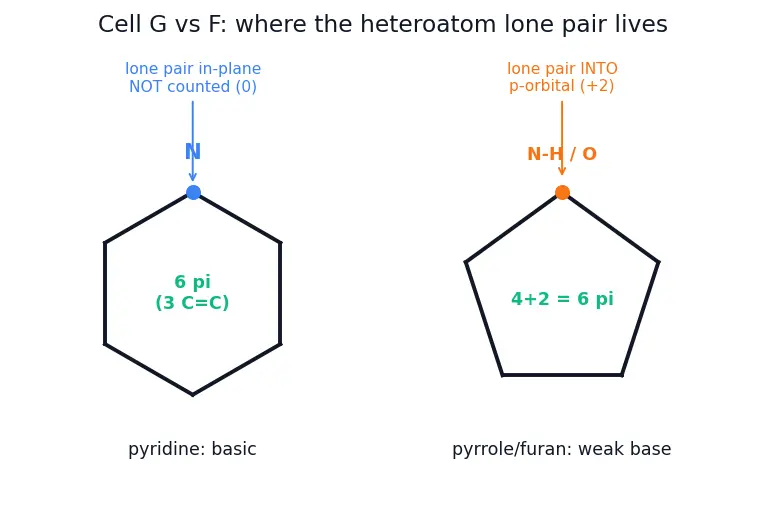
Recall Which cell is each molecule?
Benzene ::: Cell A — plain 4n+2, n=1, 6 π e⁻.
Cyclobutadiene ::: Cell B — 4n, antiaromatic.
Cyclooctatetraene ::: Cell C — puckers, non-aromatic.
Tropylium cation ::: Cell D — cation, empty p-orbital, 6 π e⁻, aromatic.
Cyclopentadienyl anion ::: Cell E — lone pair in p-orbital, 6 π e⁻, aromatic.
Furan / pyrrole ::: Cell F — heteroatom lone pair joins the loop.
Pyridine ::: Cell G — N lone pair in-plane, not counted; still 6 π e⁻ from double bonds.
Cyclopropenyl cation ::: Cell H — n=0, 2 π e⁻, aromatic.
Naphthalene ::: Cell I — perimeter, 10 π e⁻, n=2.
Cyclopentadiene acidity ::: Cell J — deprotonation gives aromatic anion.


