Exercises — Detached bow shock
Throughout: for air, and every symbol keeps the meaning it had in the parent note —
- = upstream (incoming) Mach number = flow speed ÷ speed of sound,
- = the turning angle the body demands of the flow,
- = the biggest turn an attached oblique shock can give at that ,
- = the shock-wave angle (angle between the shock and the incoming flow),
- = the part of the Mach number pointing straight into the shock.
Level 1 — Recognition
L1.1
State the one-line rule that decides whether a shock stays attached to a sharp body or detaches into a bow shock.
Recall Solution
Compare the demanded turn to the ceiling: The number is the tallest peak of the -vs- curve at that . Ask for more turning than that peak and the θ–β–M equation simply has no real — the shock cannot stay glued on. See L1.2 for the picture.
L1.2
On the centreline (the stagnation streamline that runs straight into the nose), what is , and is the flow just behind that point subsonic or supersonic?
Recall Solution
On the centreline the shock stands perpendicular to the incoming flow, so and . A shock with is a normal shock, the strongest kind — it always drops the flow to subsonic (). That subsonic pocket is exactly what lets the air peel gently around a blunt nose.

Level 2 — Application
L2.1
Air at meets a wedge of half-angle . Given , does the shock attach or detach?
Recall Solution
Compare: . The demand exceeds the ceiling, so the shock detaches — a bow shock forms. Mechanically, the θ–β–M relation has no real that produces at .
L2.2
Keep the same wedge () but speed up to , where . Attach or detach?
Recall Solution
Now : the demand is below the ceiling, so the shock stays attached and oblique. Faster flow raises , giving the flow more "turning capacity." The moral: detachment depends on both and — speeding up can re-attach a shock that was detached.
L2.3
Centreline of a bow shock at . Using the normal-shock relation find behind the shock.
Recall Solution
On the centreline , so . Then so . Subsonic, exactly as a normal shock demands.
Level 3 — Analysis
L3.1
Use the sphere stand-off correlation to compute at and , and explain the trend physically.
Recall Solution
At : exponent , so .
At : exponent , so .
The gap shrinks as rises. Why: higher → stronger compression → denser, thinner shock layer → the shock sits closer to the nose. (The parent's quoted at uses a slightly different rounding; the trend — smaller at higher Mach — is the point.)

L3.2
As , what limiting value does approach, and what does that tell you about hypersonic shock layers?
Recall Solution
As , the exponent , so and The stand-off never reaches zero — it settles at a small finite floor. Physically, at hypersonic speeds the shock hugs the nose in a thin, dense shock layer, but a nonzero gap always remains because the subsonic pocket at the stagnation point must exist to divert the flow.
Level 4 — Synthesis
L4.1
At a body demands (detaches). You need it attached. From L2 you know . Between and , is monotonically increasing. Estimate the minimum Mach number at which first reaches , given the data points and .
Recall Solution
We want the where . It lies between the two given points. Linear interpolation on vs : So at roughly the shock re-attaches. Below that it stays detached; above it, attached. This ties together the detachment criterion with the fact that rises with .
L4.2
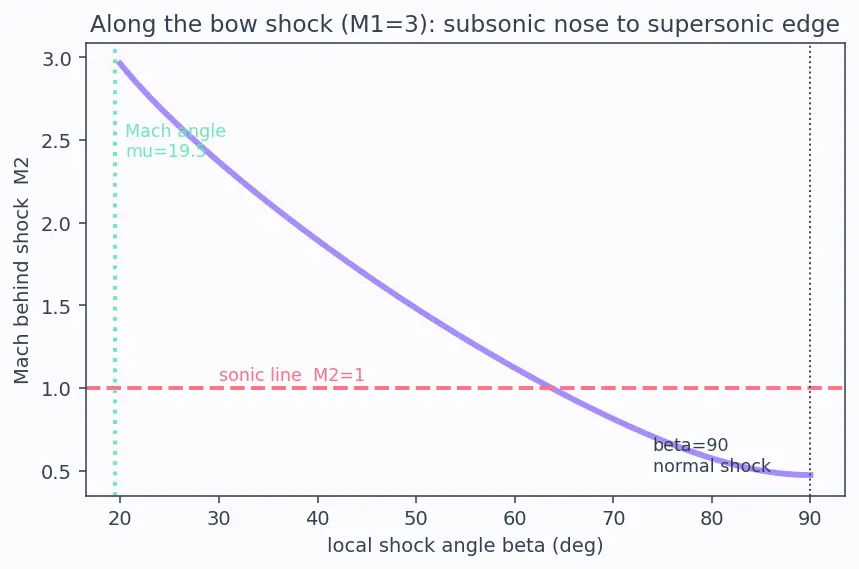
Take and follow the curved bow shock outward from the centreline. At the centreline (normal shock, ). Far out, approaches the Mach angle . Compute , and describe what happens to between and .
Recall Solution
Mach angle: . Sweeping from down to , falls from toward . The shock weakens continuously:
- near the centreline (subsonic),
- at the sonic line ,
- beyond it (supersonic again),
- in the limit , and the "shock" fades into a zero-strength Mach wave.
One curved shock thus contains an entire family of oblique strengths, from strongest (normal) to vanishing.

Level 5 — Mastery
L5.1
Inverse problem. Behind the centreline normal shock of a bow shock you measure . Recover the upstream (i.e. , since ). Use
Recall Solution
Set and solve for . With : Cross-multiply: . Since , . So a centreline implies an incoming Mach of about .
L5.2
Stagnation check. For the flow of L5.1 (, ), find the stagnation-pressure ratio across the centreline normal shock. Use
Recall Solution
Use , , so and . First bracket: . Second bracket: . and , so About 44% of the stagnation pressure survives — the rest is lost to the strong shock. Bow shocks are expensive: the stronger the centreline shock, the larger the total-pressure penalty.