Before solving anything, let's enumerate every case class this topic can throw at you. Each worked example below is tagged with the cell it fills.
| Cell |
Case class |
What makes it tricky |
Example |
| A |
μA−μB>0 (positive sign) |
which direction does matter flow? |
Ex 1 |
| B |
μA−μB<0 (negative sign) |
the sign flips the flow |
Ex 1 |
| C |
μA=μB (zero difference) |
degenerate: equilibrium, no flow |
Ex 2 |
| D |
Pressure changed, T fixed |
ln dependence, sign of Δμ |
Ex 3 |
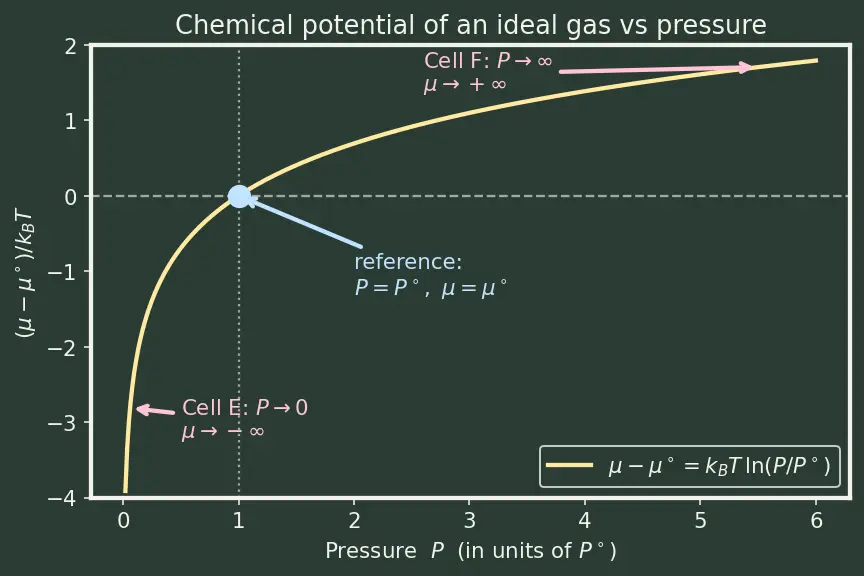
| E |
Limit P→0 (dilute) |
μ→−∞: what does that mean? |
Ex 4 |
| F |
Limit P→∞ (dense) |
μ grows without bound |
Ex 4 |
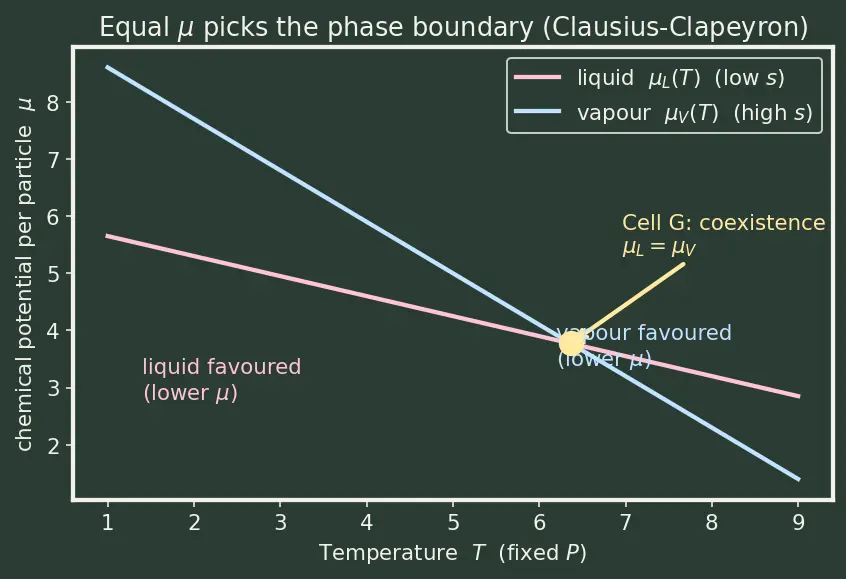
| G |
Two phases coexisting |
equal-μ picks the boundary line |
Ex 5 |
| H |
Real-world word problem |
osmosis / altitude |
Ex 6 |
| I |
Multi-species mixture |
partial molar, held-fixed subscripts |
Ex 7 |
| J |
Exam twist (sign trap) |
entropy-driven "uphill" flow |
Ex 8 |
Every cell A–J is covered below. Let's go.
The ln in Example 3 hides two dramatic limits. Let's face them head-on.
Worked example Example 6 — Osmosis: sugar water vs pure water
A membrane lets water through but not sugar. Left side: pure water. Right side: water with dissolved sugar. Which way does water flow, and what pressure Π stops it?
Forecast: Water into the sugar, or out of it?
Step 1 — Compare μw on the two sides at equal T,P (no excess pressure yet, Π=0).
- Pure side: xw=1⇒μw=μw∘+kBTln1=μw∘.
- Sugar side: xw<1⇒lnxw<0⇒μw<μw∘.
Why this step? ln of a number below 1 is negative, so dissolving sugar lowers the water's μ. The sugar side is the "mud."
Step 2 — Apply the flow rule. Water flows from high μ (pure side) to low μ (sugar side). Water crosses into the sugar solution — this is osmosis.
Why this step? Same high→low rule (Cell A); the drive is purely the entropic lnxw term, not any energy.
Step 3 — Stop it with pressure (osmotic pressure). Raise the sugar side's pressure by Π. Using the boxed formula μw=μw∘+kBTlnxw+vwΠ, equilibrium demands the water's μ match the pure side's μw∘:
μw∘+kBTlnxw+vwΠ=μw∘⇒vwΠ=−kBTlnxw≈kBTxs,
for small sugar fraction xs=1−xw. With ns = sugar particles per volume, this rearranges to van 't Hoff's law Π=nskBT.
Why this step? The only free knob to re-raise the lowered μw is pressure, and (∂μ/∂P)T=vw tells us exactly how much each unit of pressure lifts it. We solve vwΠ=−kBTlnxw.
−lnxw≈xs (the Taylor step)
Write xw=1−xs, where xs is the small sugar fraction. The natural log has the standard expansion ln(1−xs)=−xs−21xs2−31xs3−⋯. For a dilute solution xs≪1, the higher powers (xs2 and beyond) are negligible, so ln(1−xs)≈−xs, hence −lnxw=−ln(1−xs)≈xs. This is the same "keep only the first term" trick used all over physics; it is only valid because the sugar is dilute. For xs=0.010 the dropped term is 21(0.010)2=5×10⁻⁵ — utterly negligible against 0.010.
Numeric check. For xs=0.010 (1% sugar) at T=300 K: −ln(0.990)=0.010050. The osmotic drive is kBT(0.010050)=(8.617×10⁻⁵)(300)(0.010050)≈2.60×10⁻⁴ eV per water molecule.
Verify: −ln(0.99)≈0.01005, and the linear approximation xs=0.010 agrees to 0.5% ✓; osmotic drive ≈2.60×10⁻⁴ eV ✓. Sanity: adding more sugar (smaller xw) makes μw more negative, pulling more water in — matches everyday experience of a raisin swelling in water ✓.
Worked example Example 7 — Two species, get the subscripts right
A container holds N1 molecules of species 1 and N2 of species 2 at fixed T,P. Write the correct differential of G and identify each μi. Then, if only species 1 is added, what is dG?
Forecast: Is μ1 still ∂G/∂N1, or does species 2 change the rule?
Step 1 — Generalize the master differential to two species.
dG=−SdT+VdP+μ1dN1+μ2dN2.
Why this step? Each species carries its own particle-number knob. Every additional species adds one μidNi term.
Step 2 — Define each partial molar chemical potential.
μi=(∂Ni∂G)T,P,Nj=i.
Why this step? The subscript now says: hold T, P, and every other species' count fixed. If you forget "Nj=i" you're computing a different quantity — this is the parent's "subscript is essential" mistake taken to mixtures.
Step 3 — Add only species 1 at fixed T,P with dN2=0.
dG=μ1dN1.
Why this step? All other differentials vanish, leaving exactly the "cost per particle of species 1."
Verify: Note μ=G/N from the parent is only for a pure substance; here G=N1μ1+N2μ2 (Euler, Euler Relation and Gibbs-Duhem) instead. Consistency check: if species 2 is absent (N2=0), this collapses to G=N1μ1, i.e. μ1=G/N1 ✓.
Worked example Example 8 — Can particles flow toward higher
energy?
Two ideal-gas boxes at the same T. Box A is dense (PA=4.0 atm), box B is dilute (PB=1.0 atm). A student claims: "Box A is compressed, so each particle there has more energy; particles should flow A→B to lower energy — flow follows energy." Diagnose the claim and give the real answer. Take T=300 K.
Forecast: Which box has the higher μ? Does energy or μ decide the flow?
Step 1 — For an ideal gas, per-particle energy is 23kBT — it depends only on T.
Both boxes are at the same T, so they have the same energy per particle. The student's "more energy when compressed" is wrong for an ideal gas.
Why this step? This exposes the trap: compression changes μ through the entropic lnP term, not through kinetic energy.
Step 2 — Compare μ using the ideal-gas law (both share μ∘).
μA−μB=kBTlnPBPA=kBTln1.04.0=kBTln4.
Numerically: (8.617×10⁻⁵)(300)ln4=0.025851×1.386294≈0.0358 eV>0.
Why this step? ln4>0 so μA>μB. The dense box is the "mountain."
Step 3 — Apply the flow rule. High μ→ low μ: particles flow A→B (dense to dilute).
Why this step? By coincidence the student guessed the right direction — but for the wrong reason. It's not lower energy (energies are equal); it's higher entropy when the gas spreads out. The drive is the −T∂S/∂N piece of μ (parent's first steel-man mistake).
Step 4 — Show it really is entropy-driven. Since Δ(energy)=0 but the gas still flows, the entire ΔG came from the −TΔS term: spreading out into the dilute box raises the entropy per particle, so the process lowers G even though no kinetic energy was released. The lasting lesson: particles can even flow toward higher potential energy if the entropy gain is bigger — free energy, not bare energy, is the referee.
Why this step? This is the exam's real target: distinguishing free energy from bare energy. The correct diagnosis is that the student reached the right direction (A→B) by a wrong argument (energy), and the true driver is the entropic kBTln(PA/PB)>0 that makes μA>μB.
Verify: ln4≈1.3863, μA−μB≈0.0358 eV, positive ✓. Direction A→B matches "high μ→ low μ" ✓. And energies equal (23kBT both) confirms the flow is purely entropic ✓.
Recall Self-test across all cells
Cover the answers. For each, name the matrix cell and the result.
- μA=−0.2, μB=−0.9 eV: which way? ::: Cell A — A→B (A is higher).
- Two connected boxes with μA=μB: what flows? ::: Cell C — nothing; equilibrium.
- As P→0, μ→? ::: Cell E — −∞.
- Coexistence condition for a liquid and its vapour? ::: Cell G — μL=μV.
- Osmosis: does water enter or leave the sugar side? ::: Cell H — enters (sugar side has lower μw).
- In a mixture, the correct held-fixed set for μ1? ::: Cell I — T,P,Nj=1.
- Two equal-T ideal gases, dense vs dilute — flow direction and why? ::: Cell J — dense→dilute, entropy-driven.
Mnemonic The one rule that solves every cell
"Compute μsource−μdestination; if it's positive, the flow is real." Every example above is that single subtraction wearing a different costume.
Back to the parent: Chemical potential note. Related depth: Grand Canonical Ensemble (where μ becomes the control knob), Fermi-Dirac and Bose-Einstein Statistics (quantum μ), Entropy and the Second Law (why G is minimized at all).