Before anything, one reminder of the symbols so nobody is lost from line one:
Every CM problem falls into one of these cells. We will hit all of them.
| Cell |
What makes it different |
Example that covers it |
| A. Fext=0, both signs |
No external force → CM frozen; velocities have opposite signs |
Ex 1 (skaters) |
| B. Fext=0, position bookkeeping |
Displacements, one object shifts back |
Ex 2 (man on boat) |
| C. Fext=0 constant |
CM follows a real trajectory (gravity) |
Ex 3 (exploding shell) |
| D. Zero / degenerate input |
A mass or velocity is 0, or masses equal |
Ex 4 (equal masses, dropped piece) |
| E. Limiting case |
One mass →∞ or →0 |
Ex 5 (heavy wall / light fleck) |
| F. 2-D vector case |
Motion not on a line; components |
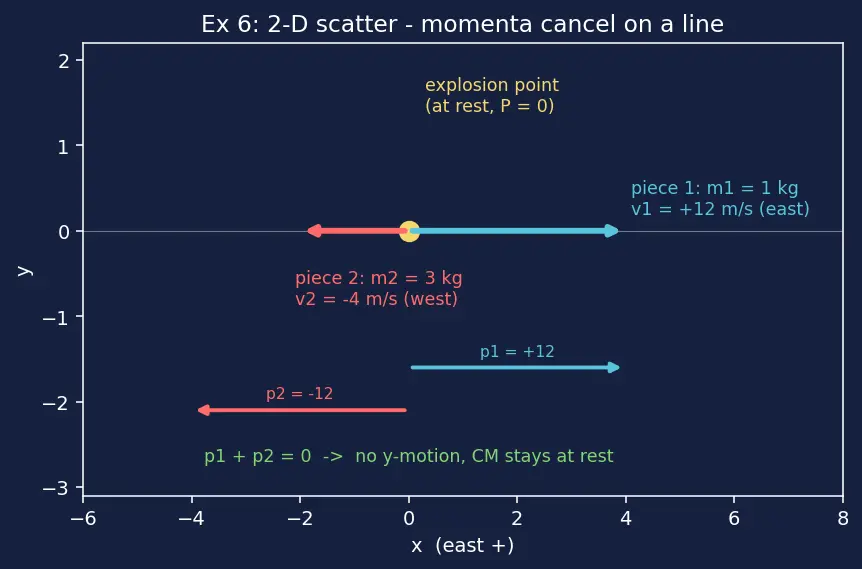
Ex 6 (L-shaped scatter) |
| G. Real-world word problem |
Translate messy words → equation |
Ex 7 (person climbs a ladder-cart) |
| H. Exam twist |
Looks like it needs more; CM shortcut wins |
Ex 8 (two blocks + spring, find where they meet) |
Let's clear every cell.
Answer to the forecast: the CM stays put. It never had a reason to move.
Answer to forecast: faster — 40 m/s.
Answer to forecast: no — a 0 kg object never moves the CM.
Answer to forecast: speed →0, but the momentum it receives stays a finite 6 kg·m/s.
Answer to forecast: nearer x=8 — the heavier block barely moves.
