Before solving anything, let's map the whole battlefield. A PMF/CDF problem can only ever land in one of these cells:
| # |
Case class |
What is different / dangerous |
Example |
| A |
Finite uniform support |
all masses equal — pure counting |
Ex 1 |
| B |
Non-uniform finite support |
masses differ; must track each |
Ex 2 |
| C |
Endpoint bracketing (< vs ≤) |
points carry mass, so which bracket matters |
Ex 3 |
| D |
Solve for a parameter |
use ∑p=1 to pin an unknown constant |
Ex 4 |
| E |
Degenerate RV |
all mass on one point; PMF/CDF collapse |
Ex 5 |
| F |
Recover PMF from a CDF staircase |
read jumps, not heights |
Ex 6 |
| G |
Countably infinite support |
infinite sum must still total 1 (geometric series) |
Ex 7 |
| H |
Real-world word problem |
translate English → RV → probability |
Ex 8 |
| I |
Exam twist — P(a≤X≤b) and left limits |
the subtle inclusive-both-ends formula |
Ex 9 |
We now hit every cell.
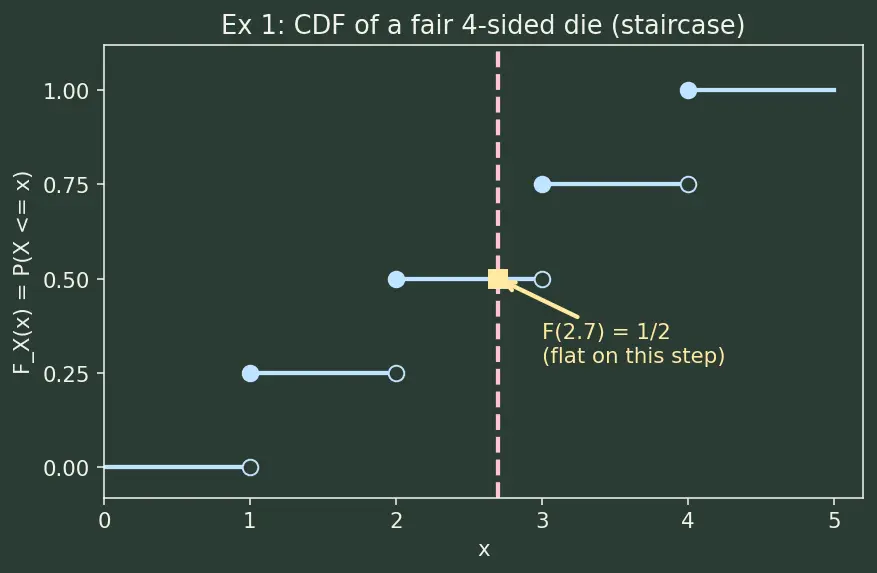
Look at the staircase: it is flat on (2,3), so anywhere in that gap — including 2.7 — gives the same height 21.
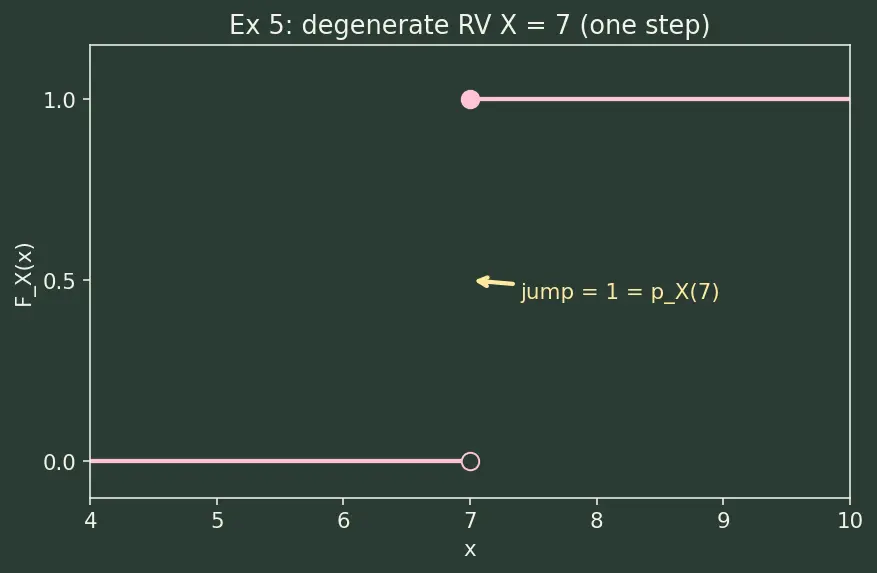
Recall Which formula gives
P(a≤X≤b) and why?
P(a≤X≤b)=FX(b)−FX(a−) ::: using a− (just left of a) keeps the mass pX(a) in, unlike FX(a) which would remove it.
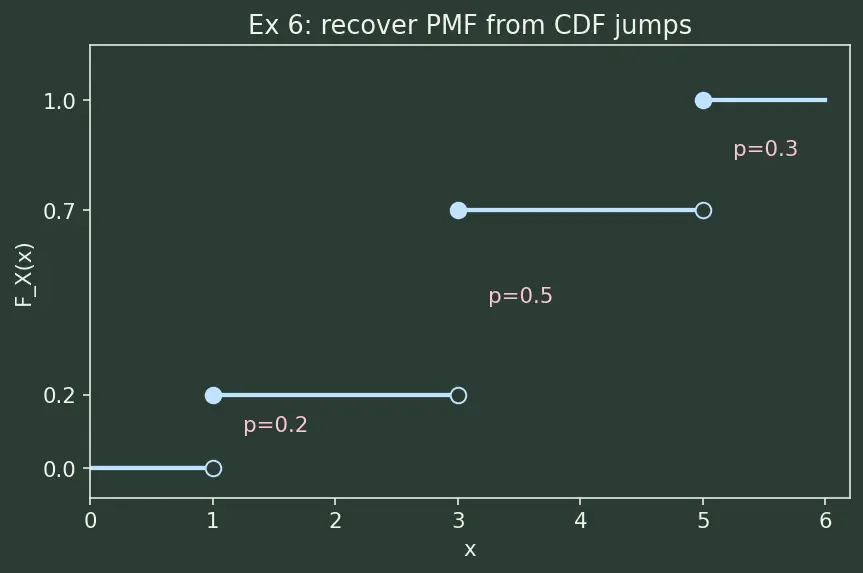
Recall How do you find a point mass
pX(xi) from a CDF staircase?
Measure the jump height ::: pX(xi)=FX(xi)−FX(xi−).
Recall For
pX(k)=(1/2)k, k≥1, why does the total equal 1?
Geometric series ::: ∑k≥1(1/2)k=1−1/21/2=1.
Recall What is the variance of a degenerate RV
X=7?
Zero ::: all mass on one point means no spread, so variance =0.
Related core notes: Discrete random variables — PMF, CDF · Probability Axioms · Continuous random variables — PDF, CDF · Expectation and Variance of Discrete RVs.


