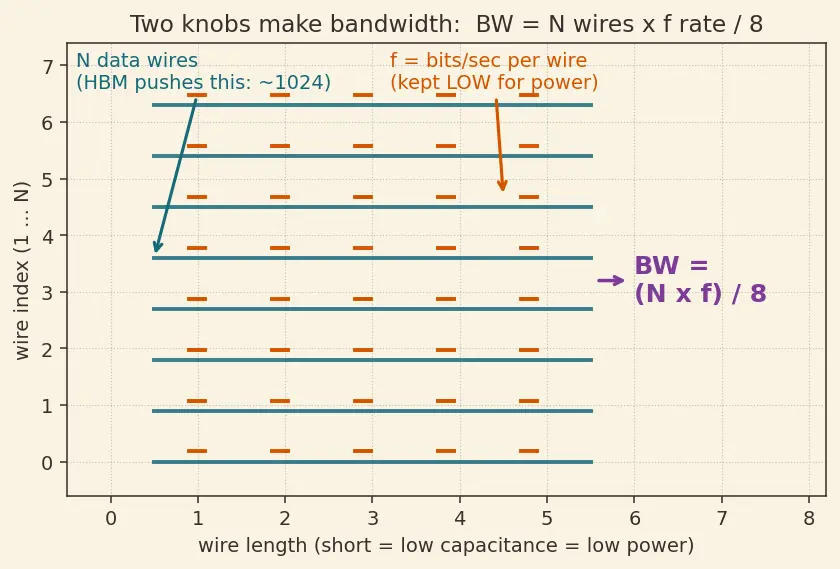
Everything here rests only on three ideas the parent already built:
- N = number of data wires (the "width" of the bus).
- f = the effective per-pin rate in bits/second per wire (what the wire actually delivers).
- Divide the bit total by 8 because there are 8 bits in a byte. See the parent topic and Memory Wall for why we chase bandwidth at all.
Every HBM numeric question falls into one of these cells. The example number that covers each cell is in the last column.
| Cell |
What varies / the twist |
Covered by |
| A. Forward, single stack |
Given N, f → find BW |
Ex 1 |
| B. Scale to many stacks |
Multiply by stack count |
Ex 2 |
| C. DDR clock trap |
Given a clock, not the effective rate |
Ex 3 |
| D. Inverse solve |
Given BW → find f or N |
Ex 4 |
| E. Degenerate — a die dies |
Fewer working channels (N shrinks) |
Ex 5 |
| F. Zero / limiting case |
What happens as f→0 or one wire only |
Ex 6 |
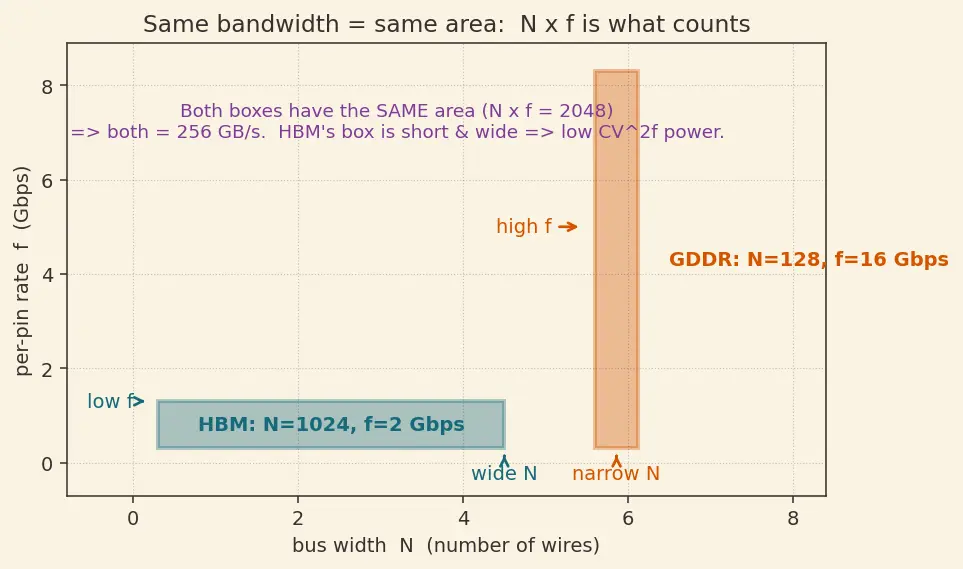
| G. Comparison (HBM vs GDDR) |
Same BW, different N,f → energy angle |
Ex 7 |
| H. Real-world word problem |
"Can memory feed the compute?" |
Ex 8 |
| I. Exam twist |
Channels doubled but bus unchanged (HBM3) |
Ex 9 |
The figures below anchor the two mental pictures the whole page needs.
Recall Which cell is this? (hide answers)
- "Given 1024-bit and 2 Gbps, find BW." ::: Cell A → 256 GB/s.
- "Clock is 1 GHz DDR, find effective rate." ::: Cell C → 2.0 Gbps (×2).
- "Stack delivers 460.8 GB/s, find f." ::: Cell D → 3.6 Gbps.
- "One of 8 channels disabled, find BW." ::: Cell E → 224 GB/s.
- "16×64 vs 8×128 — same width?" ::: Cell I → yes, both 1024 bits.
- "200 TFLOP/s ×2 B/FLOP vs 3.3 TB/s — bottleneck?" ::: Cell H → memory-bound (~122×).
- Parent topic — the theory these examples exercise.
- Through-Silicon Vias (TSV) · Silicon Interposer · 2.5D and 3D Integration — why 1024 wires per stack are even routable.
- GDDR Memory · DDR vs GDDR vs HBM · Energy per Bit / pJ per bit — the comparison in Ex 7.
- Memory Wall · GPU Architecture — the word problem in Ex 8.

