Before we compute anything, one reminder that we will lean on constantly:
Every problem about lens power lives in one of these cells. Below the table, examples E1–E9 each announce which cell they clear.
| # |
Cell (what makes it distinct) |
Key danger |
Cleared by |
| C1 |
Single convex lens, f>0 |
forget cm→m |
E1 |
| C2 |
Single concave lens, f<0 |
drop the minus sign |
E2 |
| C3 |
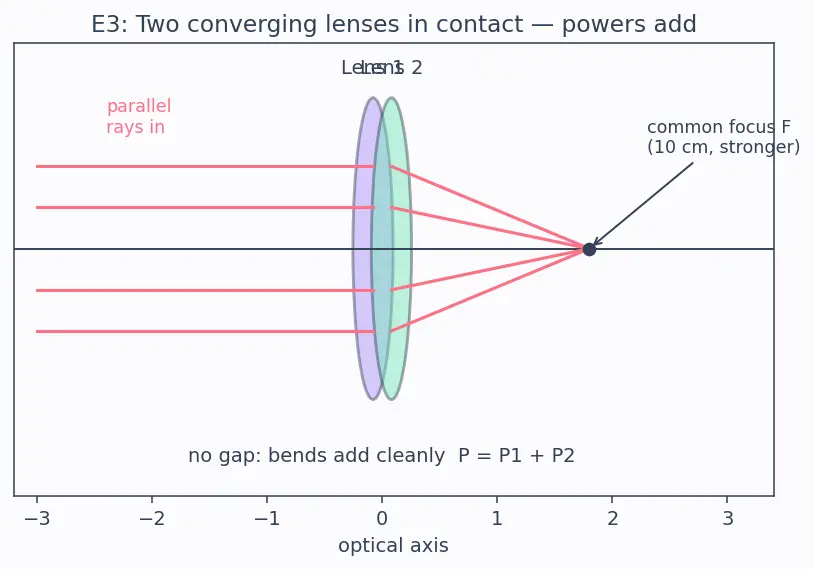
Two lenses in contact, both converging |
none — pure addition |
E3 |
| C4 |
Contact: convex + concave (opposite signs) |
sign cancellation |
E4 |
| C5 |
Contact giving net zero power (degenerate) |
F→∞, undefined 1/P |
E5 |
| C6 |
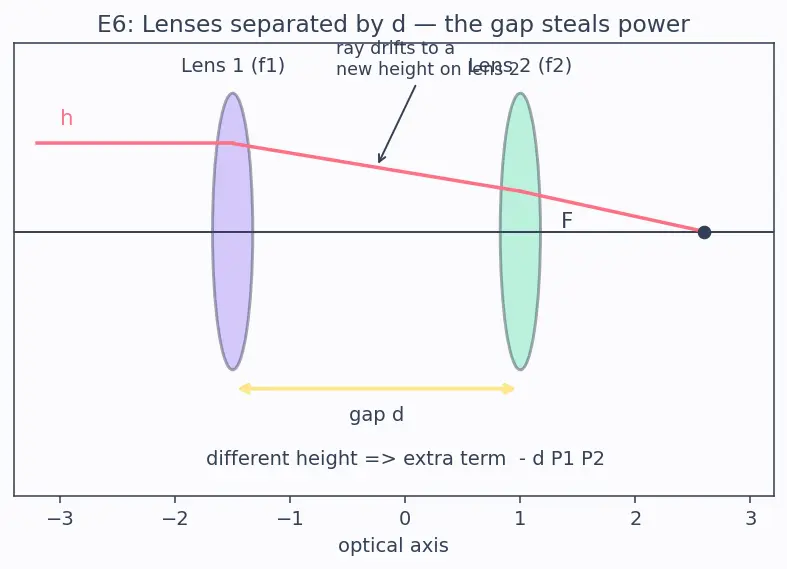
Two lenses separated by d |
must use −dP1P2 |
E6 |
| C7 |
Limiting check: let d→0 in the gap formula |
must collapse to C3/C4 |
E7 |
| C8 |
Word problem (real world: eyeglasses / corrective) |
translate words to signs |
E8 |
| C9 |
Exam twist: given combined F, find the missing lens |
reverse the arithmetic |
E9 |
Recall Which cell is each example?
E1 :: C1 single convex
E2 :: C2 single concave
E3 :: C3 two convex in contact
E4 :: C4 convex + concave in contact
E5 :: C5 net-zero degenerate
E6 :: C6 separated by d
E7 :: C7 limiting d→0 check
E8 :: C8 real-world eyeglasses
E9 :: C9 exam reverse-engineering
- Thin Lens Equation — the equation we add together for combinations.
- Lensmaker's Equation — the other route to P.
- Magnification of Lenses — net m=m1m2⋯ for these combos.
- Microscope and Telescope — the separated-lens case (E6) in action.
- Resistors in Parallel — the same reciprocal arithmetic as contact lenses.
- Defects of Vision — where E8's dioptre prescriptions come from.

