Before anything: recall the two tools we use over and over.
Every question about g falls into one of these boxes. The examples below are tagged with the box they fill.
| Cell |
Case class |
What makes it tricky |
Example |
| C1 |
Single mass, r=R (on surface) |
pick the right distance |
Ex 1 |
| C2 |
Single mass, r>R (altitude) via ratio |
don't recompute — scale by 1/r2 |
Ex 2 |
| C3 |
Two fields, same line, opposite |
vectors subtract; sign matters |
Ex 3 |
| C4 |
Two fields, null point (g=0) |
degenerate: net field vanishes |
Ex 4 |
| C5 |
Two fields at right angles |
Pythagoras, not addition |
Ex 5 |
| C6 |
Limiting behaviour: r→∞ and r→0 |
field → 0 vs. field "blows up" |
Ex 6 |
| C7 |
Inverse problem: given g, find M or r |
rearrange the formula |
Ex 7 |
| C8 |
Word problem (real world, altitude) |
translate words → r=R+h |
Ex 8 |
| C9 |
Exam twist: new planet, ratios of M and R |
combine two scalings at once |
Ex 9 |
We now fill every cell.
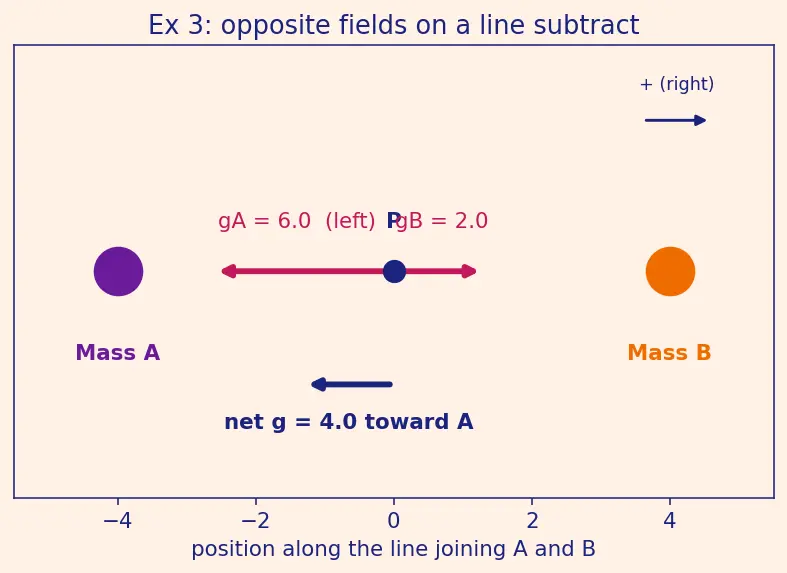
Now we need Tool B — vectors. See the picture: two masses pull the point P in opposite directions along one line.
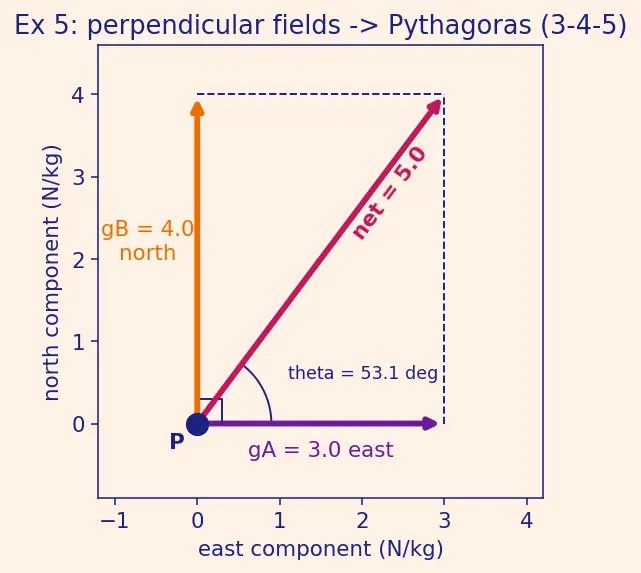
The two masses no longer sit on one line through P. See the figure: the arrows meet at 90∘, so we use Pythagoras.
Recall Which cell? Match the question to its method
- "Field at r=5R from surface g0" ::: C2 — ratio, divide by 52=25
- "Point where Earth and Moon fields cancel" ::: C4 — set magnitudes equal, null point
- "Two fields at 90∘" ::: C5 — Pythagoras on the hypotenuse
- "Given g and r, find M" ::: C7 — rearrange to M=gr2/G
- "g on a peak h above ground" ::: C8 — use r=R+h, not h

