Exercises — Permutations — nPr, arrangements with restrictions
This page assumes only what the parent note built: an arrangement is an ordered line-up, and is just " choices, then , then ... for slots." Everything else we rebuild as we need it.
Level 1 — Recognition
Goal: pick the right tool and plug in. No traps yet.
L1.1 — Read the formula
Recall Solution
WHAT we do: fill slots from distinct objects. WHY these numbers: slot 1 has all available; once one is used, slot 2 has ; then slot 3 has . Check against the compact form: ✓
L1.2 — Arrange them all
Recall Solution
Arranging everything means , so we want . WHY : there is exactly one way to arrange nothing, so dividing by changes nothing (see Factorials and 0!).
L1.3 — Spot permutation vs combination
Recall Solution
The test: does swapping the two chosen people give a different outcome? Yes — (Ana President, Bo Secretary) (Bo President, Ana Secretary). Order matters permutation, not Combinations — nCr.
Level 2 — Application
Goal: one restriction, one method.
L2.1 — Fixed position (Pattern 1)
Recall Solution
WHAT restricts: "odd" only touches the units digit, so lock that slot first (tightest constraint first).
- Units: must be odd choices.
- Thousands: any of the remaining .
- Hundreds: remaining.
- Tens: remaining.
L2.2 — Together (Pattern 2, glue)
Recall Solution
Glue the friends into one block . Now we arrange items: the block plus the other people.
- Arrange the items: .
- Inside the block the friends reorder among themselves: .
L2.3 — Apart (Pattern 3, gaps)
Recall Solution
Gaps method. First arrange the other letters : that's .
Look at the figure: three placed letters create — that is gaps.

Level 3 — Analysis
Goal: choose between complement and direct — and justify it.
L3.1 — "At least one" (complement, Pattern 5)
Recall Solution
WHY complement: "at least one even" spans many cases (one even, two even, three even). Its opposite — "no even digit at all" — is a single clean case.
- Total -digit numbers: .
- All-odd numbers use only (the odds): .
L3.2 — Both ends fixed by type (Pattern 4)
Recall Solution
Lock the two forced slots first, then fill the middle.
- First slot (vowel): choices.
- Last slot (consonant): choices.
- Middle slots: the remaining letters in any order .
L3.3 — Restriction that removes a value
Recall Solution
The hidden restriction: the leading digit can't be , so lock the thousands slot first.
- Thousands: any of choices (0 forbidden here).
- Now is back in play for the rest. Remaining slots draw from the leftover digits:
- Hundreds: choices.
- Tens: .
- Units: .
Level 4 — Synthesis
Goal: combine two or three methods in one problem.
L4.1 — Together AND a forbidden slot
Recall Solution
Glue then subtract. Treat as a block; the block gives total adjacent arrangements (parent E3). Now remove those where sits at an end. Look at the two orderings of the block:
- Block : is at an end only if the block occupies the leftmost position (so is position 1). That's block-placement for the others .
- Block : is at an end only if the block occupies the rightmost position (so is position 5). Again . Forbidden (A at an end, adjacent) .
L4.2 — Gaps with a fixed shape
Recall Solution
Gaps method, done in order.
- Arrange the boys first: .
- Four boys create gaps: .
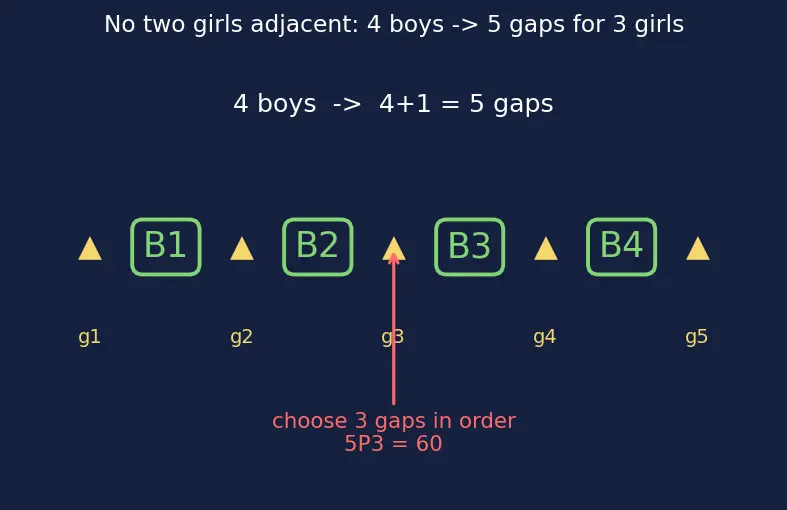
- Place girls into different gaps (different gaps never adjacent), order matters: .

L4.3 — Complement of a "together"
Recall Solution
Complement is cleaner: "not all together" total "all three together".
- Total: .
- All three together (glue ): .
Level 5 — Mastery
Goal: multi-stage counting where one wrong sub-count breaks the whole answer.
L5.1 — Digits, even, and no leading zero
Recall Solution
Two restrictions collide: units must be even , and thousands . When the units grabs , it changes what the thousands slot may use — so split on whether the units digit is .
Case A — units :
- Units: way ().
- Thousands: any of remaining (no zero conflict, already used).
- Hundreds: remaining.
- Tens: remaining.
- Subtotal .
Case B — units :
- Units: ways.
- Thousands: can't be and can't equal the units digit. From digits remove and the used even choices.
- Hundreds: remaining (now is allowed here).
- Tens: remaining.
- Subtotal .
L5.2 — Together inside a bigger count
Recall Solution
Two glue blocks.
- Glue the Maths into block , the Physics into block . Items to arrange: items .
- Inside : . Inside : .
L5.3 — Probability payoff
Recall Solution
This links straight to Probability — Equally Likely Outcomes: all orderings are equally likely, so probability .
- Total: .
- Favourable: both ends are vowels. There are exactly vowels and end-slots. Place them: . Middle letters: . Favourable .
Recall Feynman check — say it in one breath
Every one of these is the same move: line up empty slots, and at each slot ask "how many are still allowed right now?" then multiply. Restrictions just change one of those counts. When two restrictions push on the same slot (even and no leading zero), split into cases so each case has clean counts.
Answer key (fold to self-test)
Recall All numeric answers
L1: , , . L2: , , . L3: , , . L4: , , . L5: , , .
Connections
- Permutations — nPr, arrangements with restrictions — parent: the five restriction patterns.
- Fundamental Counting Principle — the "multiply the choices" engine under every solution.
- Combinations — nCr — used the swap-test to rule it out in L1.3.
- Factorials and 0! — why and .
- Circular Permutations — the row problems here become in a ring.
- Permutations with Repetition — needed only if letters/digits repeat (they don't here).
- Probability — Equally Likely Outcomes — L5.3 turns a permutation count into a probability.