Exercises — Permutations — nPr, arrangements with restrictions
2.7.10 · D4· Maths › Statistics & Probability — Intermediate › Permutations — nPr, arrangements with restrictions
Yeh page sirf wahi assume karta hai jo parent note ne build kiya: ek arrangement ek ordered line-up hoti hai, aur bas " choices, phir , phir ... slots ke liye" hai. Baaki sab hum zaroorat ke hisaab se rebuild karenge.
Level 1 — Recognition
Goal: sahi tool choose karo aur plug in karo. Abhi koi trap nahi.
L1.1 — Formula padho
Recall Solution
HUM KYA karte hain: slots fill karte hain distinct objects mein se. YEH numbers kyun: slot 1 mein saare available hain; ek use hone ke baad, slot 2 mein hain; phir slot 3 mein . Compact form se check karo: ✓
L1.2 — Sab ko arrange karo
Recall Solution
Sab kuch arrange karna matlab , toh hum chahte hain . kyun: kuch bhi nahi arrange karne ka exactly ek hi tarika hai, isliye se divide karne se kuch nahi badalta (dekho Factorials and 0!).
L1.3 — Permutation vs combination pehchano
Recall Solution
Test yeh hai: kya donon chosen logon ko swap karne se alag outcome milta hai? Haan — (Ana President, Bo Secretary) (Bo President, Ana Secretary). Order matters permutation hai, Combinations — nCr nahi.
Level 2 — Application
Goal: ek restriction, ek method.
L2.1 — Fixed position (Pattern 1)
Recall Solution
KYA restrict karta hai: "odd" sirf units digit ko touch karta hai, toh pehle woh slot lock karo (tightest constraint pehle).
- Units: odd hona chahiye choices.
- Thousands: bache hue mein se koi bhi .
- Hundreds: remaining.
- Tens: remaining.
L2.2 — Together (Pattern 2, glue)
Recall Solution
doston ko ek block mein glue karo. Ab hum items arrange karte hain: block plus baaki log.
- items arrange karo: .
- Block ke andar dost apas mein reorder kar sakte hain: .
L2.3 — Apart (Pattern 3, gaps)
Recall Solution
Gaps method. Pehle baaki letters arrange karo: woh hai.
Figure dekho: teen placed letters create karte hain — matlab gaps.

Level 3 — Analysis
Goal: complement aur direct mein choose karo — aur justify karo.
L3.1 — "At least one" (complement, Pattern 5)
Recall Solution
Complement kyun: "at least one even" kai cases span karta hai (ek even, do even, teen even). Iska opposite — "koi bhi even digit nahi" — ek single clean case hai.
- Total -digit numbers: .
- All-odd numbers sirf (woh odds) use karte hain: .
L3.2 — Dono ends type se fixed (Pattern 4)
Recall Solution
Pehle do forced slots lock karo, phir middle fill karo.
- Pehla slot (vowel): choices.
- Aakhri slot (consonant): choices.
- Beech ke slots: bache hue letters kisi bhi order mein .
L3.3 — Restriction jo ek value remove karta hai
Recall Solution
Hidden restriction: leading digit nahi ho sakta, toh pehle thousands slot lock karo.
- Thousands: mein se koi bhi choices ( forbidden hai yahan).
- Ab baaki ke liye wapas available hai. Remaining slots leftover digits se draw karte hain:
- Hundreds: choices.
- Tens: .
- Units: .
Level 4 — Synthesis
Goal: ek problem mein do ya teen methods combine karo.
L4.1 — Together AUR ek forbidden slot
Recall Solution
Glue then subtract. ko ek block treat karo; block total adjacent arrangements deta hai (parent E3). Ab woh arrangements nikalo jahan end par baithta hai. Block ke do orderings dekho:
- Block : end par tabhi hota hai jab block sabse leftmost position par ho (toh position 1 par hai). Woh block-placement baaki ke liye hai.
- Block : end par tabhi hota hai jab block sabse rightmost position par ho (toh position 5 par hai). Phir se . Forbidden ( end par, adjacent) .
L4.2 — Gaps with a fixed shape
Recall Solution
Gaps method, order mein karo.
- Pehle boys arrange karo: .
- Chaar boys gaps create karte hain: .
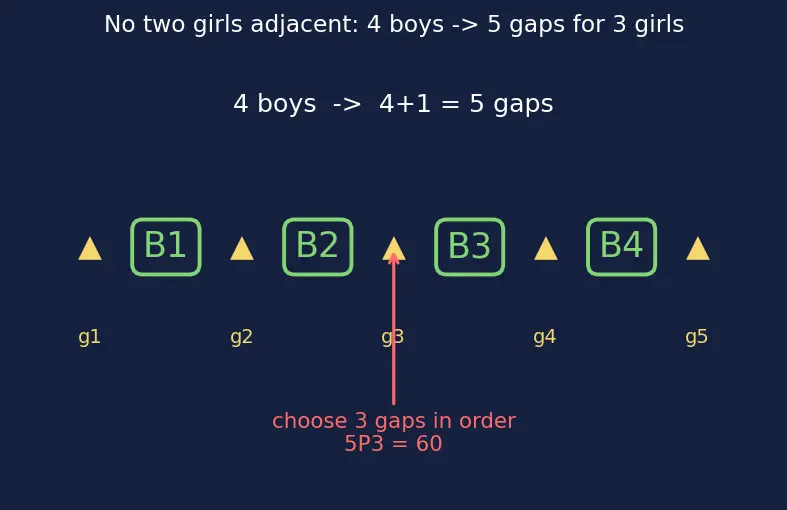
- girls ko alag gaps mein place karo (alag gaps kabhi adjacent nahi), order matters: .

L4.3 — "Together" ka complement
Recall Solution
Complement zyada clean hai: "saath nahi" total "teeno saath".
- Total: .
- Teeno saath (glue ): .
Level 5 — Mastery
Goal: multi-stage counting jahan ek galat sub-count poora answer toda deta hai.
L5.1 — Digits, even, aur no leading zero
Recall Solution
Do restrictions collide karte hain: units even hona chahiye , aur thousands . Jab units leta hai, toh thousands slot kya use kar sakta hai woh badal jaata hai — isliye split karo units digit hai ya nahi us par.
Case A — units :
- Units: way ().
- Thousands: bache hue mein se koi bhi (koi zero conflict nahi, already use ho gaya).
- Hundreds: remaining.
- Tens: remaining.
- Subtotal .
Case B — units :
- Units: ways.
- Thousands: nahi ho sakta aur units digit ke barabar nahi ho sakta. digits mein se aur use kiya gaya even hatao choices.
- Hundreds: remaining (ab yahan allowed hai).
- Tens: remaining.
- Subtotal .
L5.2 — Ek bade count ke andar Together
Recall Solution
Do glue blocks.
- Maths ko block mein, Physics ko block mein glue karo. Arrange karne ke items: items .
- ke andar: . ke andar: .
L5.3 — Probability payoff
Recall Solution
Yeh seedha Probability — Equally Likely Outcomes se link karta hai: saare orderings equally likely hain, toh probability hai.
- Total: .
- Favourable: dono ends vowels hain. Exactly vowels aur end-slots hain. Unhe place karo: . Beech ke letters: . Favourable .
Recall Feynman check — ek saans mein bolo
Yeh sab same move hai: khaali slots line up karo, aur har slot par poochho "abhi kitne allowed hain?" phir multiply karo. Restrictions sirf un counts mein se ek ko change karti hain. Jab do restrictions ek hi slot par push karti hain (even aur no leading zero), cases mein split karo taaki har case ke counts clean hon.
Answer key (self-test ke liye fold karo)
Recall Saare numeric answers
L1: , , . L2: , , . L3: , , . L4: , , . L5: , , .
Connections
- Permutations — nPr, arrangements with restrictions — parent: paanch restriction patterns.
- Fundamental Counting Principle — har solution ke neeche "choices multiply karo" engine.
- Combinations — nCr — L1.3 mein swap-test se rule out kiya gaya.
- Factorials and 0! — kyun aur .
- Circular Permutations — yahan ke row problems ring mein ban jaate hain.
- Permutations with Repetition — sirf tab chahiye jab letters/digits repeat hon (yahan nahi karte).
- Probability — Equally Likely Outcomes — L5.3 ek permutation count ko probability mein turn karta hai.