Everything here rests on one fact from the parent:
Below is the full menu of situations. Every cell is covered by at least one worked example (its label in brackets).
| # |
Case class |
What makes it special |
Covered by |
| C1 |
m1>0 (positive slope) |
perpendicular slope is negative |
Ex 1 |
| C2 |
m1<0 (negative slope) |
perpendicular slope is positive |
Ex 2 |
| C3 |
m1 a fraction |
flip and negate a fraction cleanly |
Ex 3 |
| C4 |
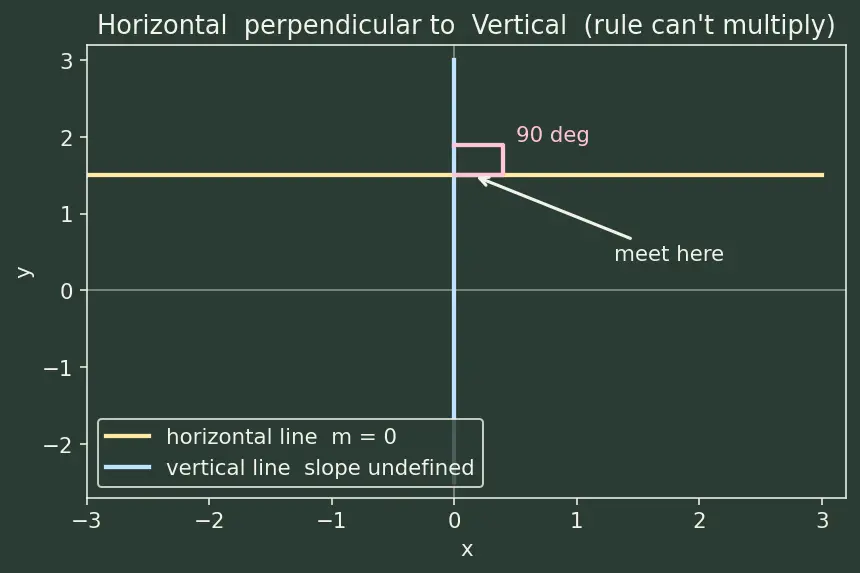
m1=0 (horizontal) |
reciprocal undefined → vertical line |
Ex 4 |
| C5 |
vertical line (slope undefined) |
rule doesn't apply → horizontal |
Ex 4 |
| C6 |
slope from two points |
build m1 first, then perpendicular |
Ex 5 |
| C7 |
equation of a perpendicular line through a point |
combine with Equation of a Line — point-slope form |
Ex 6 |
| C8 |
real-world word problem |
translate a story into slopes |
Ex 7 |
| C9 |
exam twist: unknown parameter |
solve for a letter using m1m2=−1 |
Ex 8 |
| C10 |
geometry check: is a triangle right-angled? |
test one pair of sides |
Ex 9 |
| C11 |
limiting behaviour (m1→∞ and m1→0) |
what the negative reciprocal tends to |
Ex 10 |
Here the formula m2=−1/m1 cannot be used, so we reason from the picture instead.
Recall Cover and answer
- Perpendicular slope of m1=−72?
- Which two cases make the product rule unusable, and what do you do instead?
- If y=kx−1⊥y=32x+4, what is k?
- In Example 9, which two side-slopes did you multiply, and to what value?
Answers: 1) +27. 2) Horizontal (m=0) and vertical (undefined) — check geometrically, they're perpendicular. 3) k=−23. 4) mBA=21 and mBC=−2, product =−1.
