Before anything, three tools we lean on the whole page — defined from zero:
Every worked example below is tagged with the cell of this matrix it covers. Together they hit all cells.
| Cell |
Case class |
What makes it tricky |
Example |
| A |
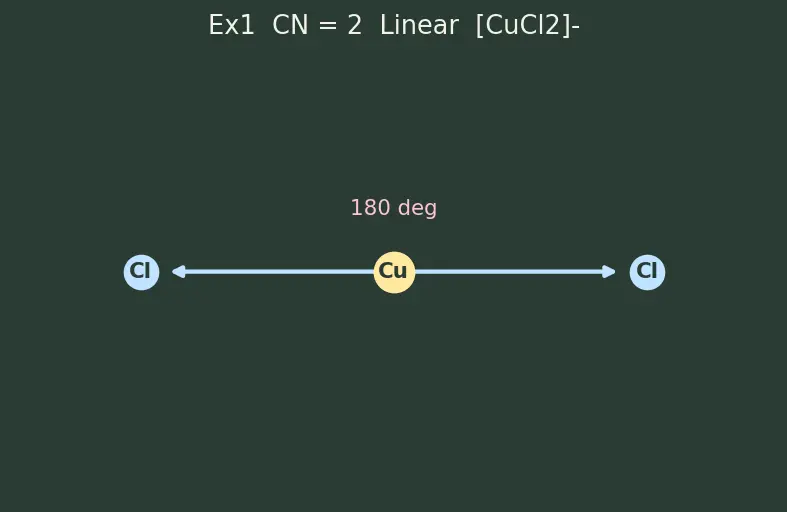
CN = 2, d10 |
recognise linear from d-count |
Ex 1 |
| B |
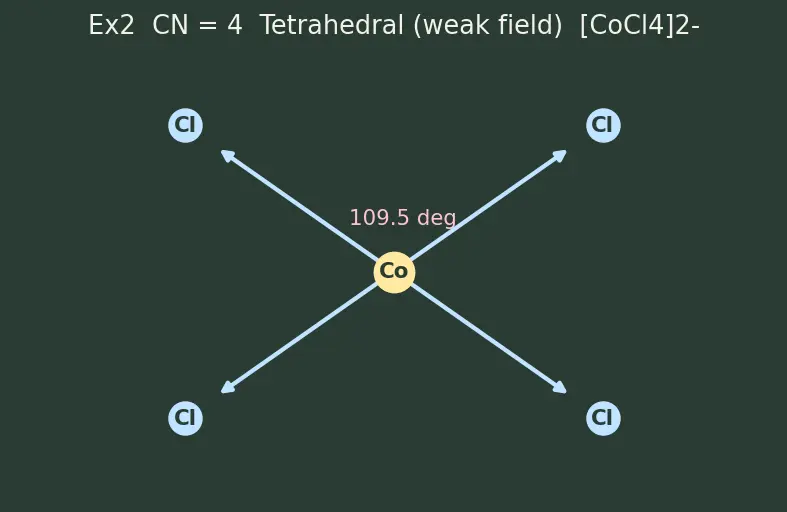
CN = 4, tetrahedral (weak field) |
default VSEPR shape |
Ex 2 |
| C |
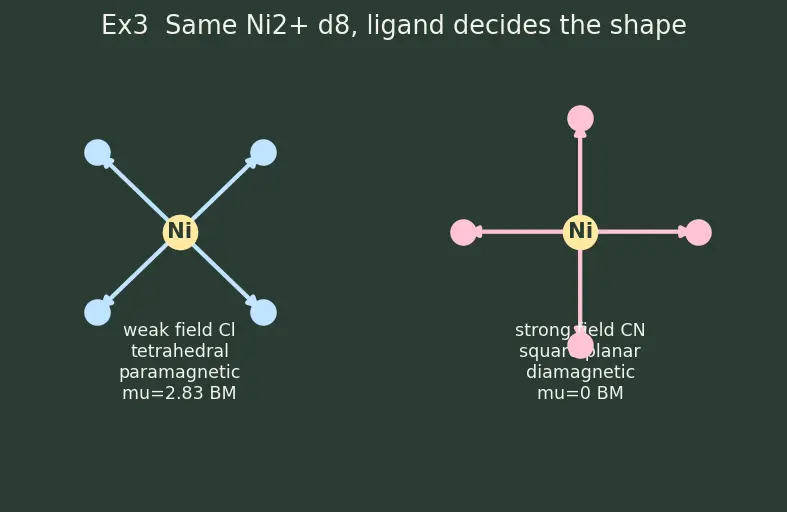
CN = 4, square planar (d8 strong field) |
geometry flip |
Ex 3 |
| D |
Same metal, two geometries |
ligand decides, not metal |
Ex 3 (contrast) |
| E |
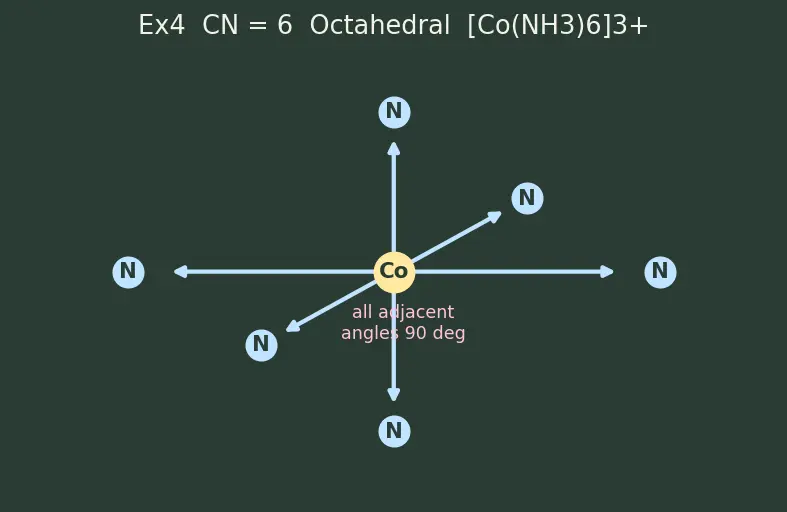
CN = 6, octahedral, monodentate |
plain count + why nothing flips it |
Ex 4 |
| F |
CN from chelating ligand |
count donor atoms not molecules |
Ex 5 |
| G |
Mixed denticity (the sum formula) |
apply ∑nidi |
Ex 6 |
| H |
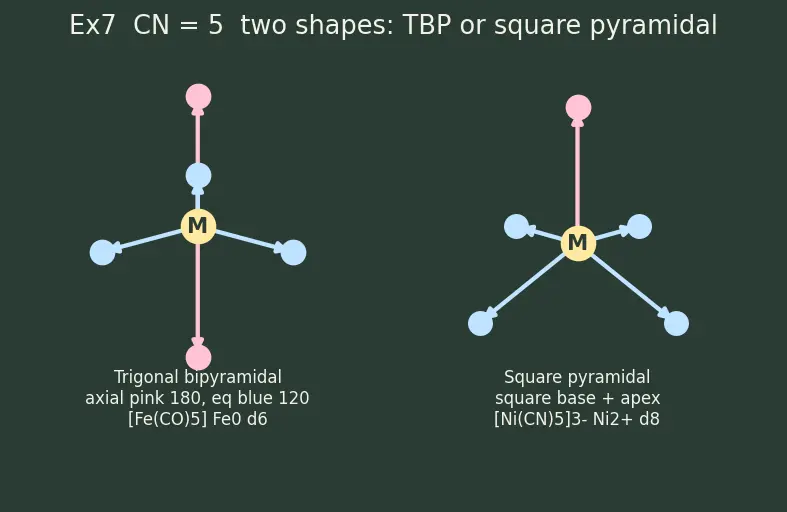
CN = 5, odd coordination (TBP / square pyramidal) |
the "in-between" shapes |
Ex 7 |
| I |
Degenerate / "zero" case (bare ion, CN = 0) |
limiting behaviour |
Ex 8 |
| J |
Real-world word problem |
translate words → CN → shape |
Ex 9 |
| K |
Exam twist (same formula, different answer) |
oxidation state changes d-count |
Ex 10 |
Recall Self-test: name the cell
[Au(CN)2]− shape and CN? ::: CN = 2, linear (d10 Au⁺) — Cell A.
[PtCl4]2− shape? ::: Square planar (d8 Pt²⁺, 4d/5d strongly prefer square) — Cell C.
Two shapes possible for CN = 5? ::: Trigonal bipyramidal and square pyramidal (near-equal energy) — Cell H.
CN of [Cr(EDTA)]−? ::: 6 (EDTA hexadentate, 1×6) — Cell G, octahedral.
Geometry of a bare gaseous Cu2+? ::: Undefined, CN = 0 — Cell I.


