Shuru karne se pehle, hum — general Riccati equation se, seedha is page pe — woh scalar formula dobara banate hain jis par hum baar baar bharosa karte hain, taaki neeche ka kuch bhi parent note ko yaad rakhne par depend na kare.
Har LQR problem inhi cells mein se kisi ek mein aata hai. Har column ek knob hai; har row us knob ki ek value hai. Neeche ke worked examples batate hain ki woh kaunse cell(s) mein aate hain.
Cell
Plant ka sign / structure
Weight regime
Kya stress-test hota hai
A
Scalar, stable (a<0)
balanced q=r
baseline, positive root
B
Scalar, unstable (a>0)
balanced
control ko stability banana padega
C
Scalar, marginal (a=0)
balanced
integrator edge case
D
Scalar
cheap controlr→0
limiting: gain blast ho jaata hai
E
Scalar
expensive controlr→∞
limiting: gain fade hota hai, plant pe depend karna padega
Forecast: plant pehle se hi stable hai (a=−2<0). Kya tumhe lagta hai LQR phir bhi pole ko aur left mein kheenchega, ya chhodega? Padhne se pehle andaza lagao.
Quadratic solve karo, positive root rakho.p2+4p−1=0 likhte hain, toh p=2−4+16+4=−2+5≈0.236.
Positive root kyun?V=px2 ek cost hai aur ≥0 honi chahiye, isliye p>0 zaroori hai; doosra root −2−5≈−4.24 negative hai aur reject ho jaata hai.
Gain compute karo.K=rbp=p≈0.236.
Closed-loop pole.a−bK=−2−0.236=−2.236.
Verify: open-loop pole tha −2; closed loop hai −2.236, left half-plane mein aur andar. Toh LQR ek pehle se stable plant ko bhi thoda aur push karta hai — thoda control kharach karke thoda kam error karta hai. Sanity check: a−bK<0, stable. ✔
Forecast: ek unstable plant apne aap bhaag jaata hai. Kya ek fixed gain K use control kar sakta hai, aur pole kitna left ja sakta hai?
Numbers ke saath Riccati.2ap−rb2p2+q=6p−4p2+4=0.
Standard quadratic form mein laane ke liye (positive leading coefficient), dono taraf −1 se multiply karo: 4p2−6p−4=0, phir 2 se divide karo: 2p2−3p−2=0.
Ye manipulation kyun?−1 se multiply karne par p2 coefficient positive ho jaata hai toh quadratic formula saaf padhta hai; common factor 2 se divide karne par numbers chhote ho jaate hain. Dono operations roots nahi badlte (ek equation "=0" ko nonzero constant se multiply karne par solutions waahi rehte hain).
Verify:+3 pe shuru hua (bhaag raha tha), −5 pe khatam hua (decay ho raha hai). Controller ne pole ka sign flip kar diya — bilkul wahi promise jo LQR karta hai ki koi bhi controllable plant stable hoga. ✔
Forecast:a=0 ke saath plant na badhta hai na ghatata hai — bas hold karta hai. Kya formula phir bhi clean answer deta hai?
Riccati.2(0)p−41p2+1=0⇒−41p2+1=0⇒p2=4.
Ye step kyun?2ap term zero ho jaata hai kyunki a=0 hai; quadratic sirf ek pure square mein collapse ho jaati hai.
Positive root.p2=4 ke roots hain p=+2 aur p=−2; hum p=2 rakhte hain.
p=−2 reject kyun? Bilkul wahi reason jaise har scalar case mein: V=px2 cost-to-go hai aur kabhi negative nahi ho sakti, isliye p≥0 chahiye. Root −2 kisi bhi x=0 ke liye V<0 banata, jo meaningless hai, isliye discard ho jaata hai.
Gain.K=rbp=41⋅2=0.5.
Closed loop.a−bK=0−0.5=−0.5<0.
Verify:a=0 ke saath Riccati padhti hai rb2p2=q, toh p=qr/b (yahan b>0 lete hain). Numerically p=1⋅4/1=2, step 2 se match. ✔ Clean edge case, stable.
Forecast: agar control almost free hai (r→0), toh gain bada hona chahiye ya chhota? Agar control almost forbidden hai (r→∞), toh hum kis pole par phanse rahenge?
Apne box se general root lo. Dobara derive kiya hua scalar formula
p(r)=b2ar+a2r2+qrb2
upar 2ap−rb2p2+q=0 par quadratic formula apply karke mila tha. a=b=q=1 substitute karo:
p(r)=r+r2+r.Ye step kyun? Ye p (aur isliye K) ko single knob r ke explicit function ke roop mein express karta hai, taaki hum seedha limits le sakein instead of har r ke liye quadratic dobara solve karne ke.
r ke function mein gain.K(r)=rbp=rr+r2+r=1+1+r1.
Aise kyun likhein?r se divide karne par (aur r root ke andar kheenchne par: r2+r/r=1+1/r) woh r1 term isolate ho jaata hai jiska limit directly padha ja sakta hai.
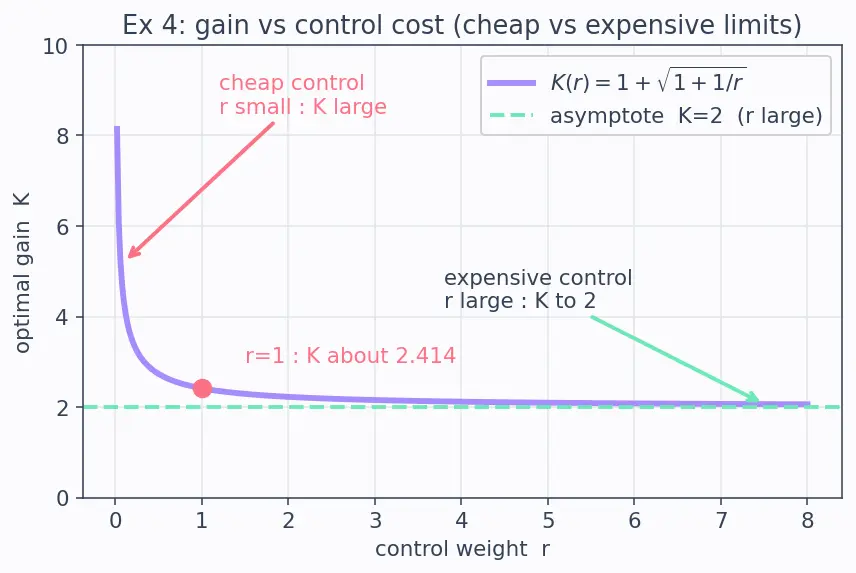
Cheap control, r→0+.r1→∞, toh K→∞.
Kyun? Control almost free hai, toh optimizer unlimited effort kharach karta hai → infinite gain → pole a−bK→−∞ (instant correction). Ye D-cell limit hai.
Expensive control, r→∞.r1→0, toh K→1+1=2; pole a−bK→1−2=−1.
K→0 kyun nahi? Kyunki a=1unstable hai — tum kharcha karna kabhi poora nahi rok sakte, warna state bhaag jaati hai. Controller us sabse saste gain par settle karta hai jo phir bhi stabilize kare, plant ki apni rate ko mirror karte hue. Ye mirror-image pole (−∣a∣) ek famous LQR fact hai (cheap-vs-expensive limit).
Figure. Horizontal axis control weight r hai (0 se 8 tak); vertical axis optimal gain K hai. Lavender curve K(r)=1+1+1/r left par +∞ se ghoom kar right par mint dashed asymptote K=2 tak aa jaata hai; coral dot value K(1)≈2.414 mark karta hai.
Verify:r=1 par, K=1+2≈2.414 — parent note ke worked number se exactly match. ✔ Do asymptotes (K→∞ aur K→2) ise sahi bracket karte hain.
Forecast:dono penalties ko same factor se scale karna — kya controller zyada aggressive, kam aggressive, ya unchanged hoga?
Ratio ke terms mein general gain.a=b=1 ke saath positive root (box se) hai p=r+r2+qr, toh
K=rp=1+1+rq.Ye step kyun?r ko square root se bahar nikalo: r2+qr=r1+q/r. r se divide karne ke baad, sirf ratioq/r bachta hai — koi standalone q ya r nahi rehta.
Case (1,1):q/r=1, toh K=1+2≈2.414.
Case (100,100):q/r=1 phir se, toh K=1+2≈2.414. Identical.
Verify: dono gains numerically equal hain kyunki K sirf q/r par depend karta hai. Ye parent-note ki mistake #1 confirm karta hai: sirf ratio aggressiveness set karta hai, dono ko scale karna no-op hai. ✔
Forecast: LQR yahan PD controller ban jaata hai. Kaunsa damping ratio expect karna chahiye?
CARE ko entry by entry expand karo (yahan kiya gaya hai, assume nahi).A⊤P+PA−PBR−1B⊤P+Q=0 aur B⊤P=[p2,p3] ke saath, toh PBR−1B⊤P=ρ1[p22p2p3p2p3p32], teen scalar equations hain:
(1,1): 1−p22/ρ=0,
(1,2): p1−p2p3/ρ=0,
(2,2): 2p2−p32/ρ=0.
Ye step kyun? Ek symmetric 2×2 matrix equation exactly teen independent scalar equations deti hai — ek per distinct entry — jinhe hum order mein solve karte hain.
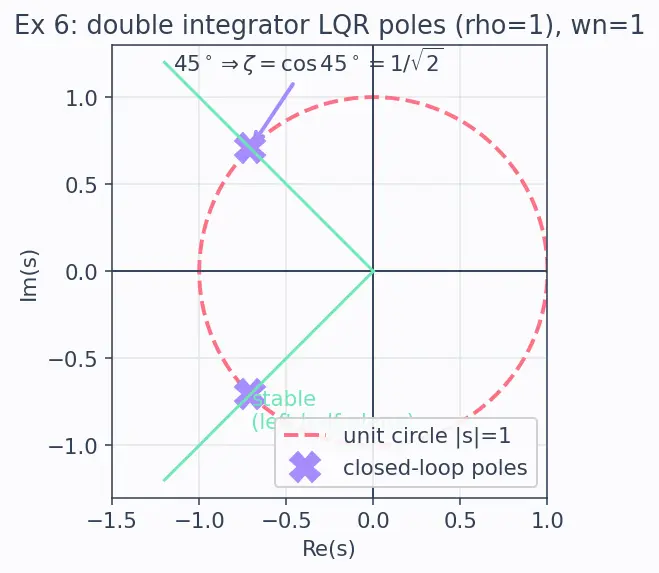
Figure. Axes complex s-plane hain: horizontal = real part Re(s), vertical = imaginary part Im(s). Do lavender crosses closed-loop poles hain −1/2±j/2 par; woh coral unit circle (∣s∣=1) par left half-plane mein 45∘ par baithe hain — damping ratio ζ=cos45∘=1/2.
Natural frequency. Is plant par LQR ke liye, ωn=kp=1/ρ=ρ−1/4=16−1/4=0.5.
Kyun? Closed-loop poly hai s2+kds+kp, toh ωn=kp=0.25=0.5.
Verify: Example 6 se compare karein (ωn=1), ρ16× badha aur ωn161/4=2× gira (1 se 0.5 tak). Dheema aur gentle, exactly waise jaisa "expensive control" predict karta hai. Damping check: ζ=kd/(2ωn)=0.7071/(2⋅0.5)=0.7071=1/2 — same damping ratio (is problem ki ek scale-invariance). ✔
Forecast:Q ka ek zero eigenvalue hai, toh hum velocity ke baare mein kuch bhi directly penalize nahi kar rahe. Kya solution phir bhi dono states ko stabilize karta hai?
Requirement batao. Ek stabilizing P⪰0 exist karta hai iff (A,B) controllable aur(A,Q) observable ho (Controllability and Observability).
Ye step kyun? Ek degenerate Q theek hai jab tak penalized quantity dynamics ke through har unstable mode ko "dekhti" hai.
(A,C) ki Observability.O=[CCA]=[1001], rank 2 = full.
Ye humein kyun bachaata hai? Bhale hi hum velocity directly penalize nahi karte, velocity position se observable hai CA ke through (position ki rate velocity reveal karti hai). Toh cost phir bhi ek runaway velocity "feel" karti hai.
Consequence. Example-6 solution K=[1,2] valid aur stabilizing hai degenerate Q ke bawajood.
Verify: observability matrix 2×2 identity hai, determinant =1=0 ⇒ full rank ⇒ LQR well-posed. ✔ (Ise Cell I se contrast karo next mein, jahan plant itself ek condition fail karta hai.)
Forecast: control u sirf pehli row mein enter karta hai. Unstable mode x2 hai. Kya koi gain use touch kar sakta hai?
Controllability matrix banao.C=[B,AB]. AB=[0001][10]=[00].
Toh C=[1000].
Ye step kyun?(A,B) controllable ⟺ C ka full rank n=2 ho (Controllability and Observability).
Rank.detC=0, rank =1<2. Uncontrollable.
Kaunsa mode diagnose karo. Uncontrollable mode x2 hai, jiska eigenvalue +1 (unstable) hai. Ek unstable aur uncontrollable mode kisi bhi u=−Kx se move nahi ho sakta.
Ye LQR ko kyun khatam karta hai? Koi bhi feedback gain us pole ko push nahi kar sakta jahan control pahunch nahi sakta. Riccati equation ek stabilizing P⪰0 yield nahi karega.
Conclusion. LQR ka yahan koi stabilizing solution nahi hai; tumhe actuator (B) redesign karna hoga taaki woh x2 mein couple ho sake.
Verify:detC=1⋅0−0⋅0=0 ⇒ rank-deficient ⇒ uncontrollable. Recipe sahi tarike se fail hoti hai. ✔ Ye boundary case hai jise har LQR user ko pehchanna chahiye.
Forecast: humne ωn=ρ−1/4 nikala tha. 0.5 tak dheela karne ke liye, kya ρ bada karte hain ya chhota?
Frequency relation invert karo. Example 7 se, ωn=ρ−1/4, toh ρ=ωn−4=(0.5)−4=16.
Ye step kyun? Humne ωn=ρ−1/4 derive kiya tha; ρ ke liye solve karne par required control weight milta hai. Bada ρ (expensive control) ⇒ dheema response — forecast se match.
Gain compute karo (Example 7 reuse karo).K=[0.25,0.7071].
Engineering reading.kp=0.25 (torque per radian) = restoring "spring"; kd=0.707 (torque per rad/s) = damping. Damping ratio ζ=1/2≈0.707 → lagbhag 5% overshoot, ek smooth slew.
Satellite ke liye ye achha kyun hai? Kam ωn ⇒ gentle wheel torques ⇒ kam power aur kam structural stress, dheemai settle ke cost par. Dekho LQG Control jab state pehle estimate karni ho.
Verify:ρ=16⇒ωn=16−1/4=0.5 ✔; K=[0.25,0.7071] ✔ (bilkul Example 7 jaisa, jaisa hona chahiye — same ρ hai).
Recall Coverage checklist (kya humne har cell cover kiya?)
A ✔ (Ex 1) · B ✔ (Ex 2) · C ✔ (Ex 3) · D & E ✔ (Ex 4) · H ✔ (Ex 5) · F ✔ (Ex 6, 7) · G ✔ (Ex 8) · I ✔ (Ex 9) · J ✔ (Ex 10). Stable/unstable/marginal scalars, cheap/expensive limits, ratio-invariance, matrix PD case, degenerate-but-OK Q, aur uncontrollable failure — sab dikhaaya gaya.