Before anything, one reminder of the symbols so you never guess:
Recall The symbols, in plain words
- Z ::: the partition function, Z=∑ie−βEi — one number that sums the "Boltzmann weight" of every microstate.
- β ::: shorthand for 1/(kBT). Big β = cold; small β = hot.
- kB ::: Boltzmann's constant ≈1.381×10⁻²³ J/K — the conversion factor between temperature and energy.
- F ::: Helmholtz free energy, F=−kBTlnZ.
- U ::: average (internal) energy, U=−∂βlnZ.
- ε ::: the energy gap of a two-level system.
Prerequisites live at Boltzmann distribution and microstates and Entropy — Gibbs and Boltzmann definitions; the master result is on the parent topic.
Every problem this topic can throw at you falls into one of these cells. The "Example" column tells you which worked example nails that cell.
| # |
Case class |
What is special |
Example |
| A |
Degenerate input: one accessible state |
Z=1, so lnZ=0 |
Ex 1 |
| B |
Low-T limit (β→∞) |
System freezes into ground state |
Ex 2 |
| C |
High-T limit (β→0) |
All states equally likely |
Ex 2 |
| D |
Finite discrete sum, general T |
Two-level system, all T |
Ex 2 |
| E |
Continuous integral instead of sum |
Classical DOF, Gaussian integral |
Ex 3 |
| F |
Extensive / many independent parts |
Z=Z1N, F∝N |
Ex 4 |
| G |
Real-world word problem |
Numbers, units, an actual answer |
Ex 5 |
| H |
Exam twist: degeneracy factor |
States with multiplicity g |
Ex 6 |
| I |
Sign / limiting sanity of S,p |
Checking S=−∂TF everywhere |
Ex 7 |
We now walk each cell.
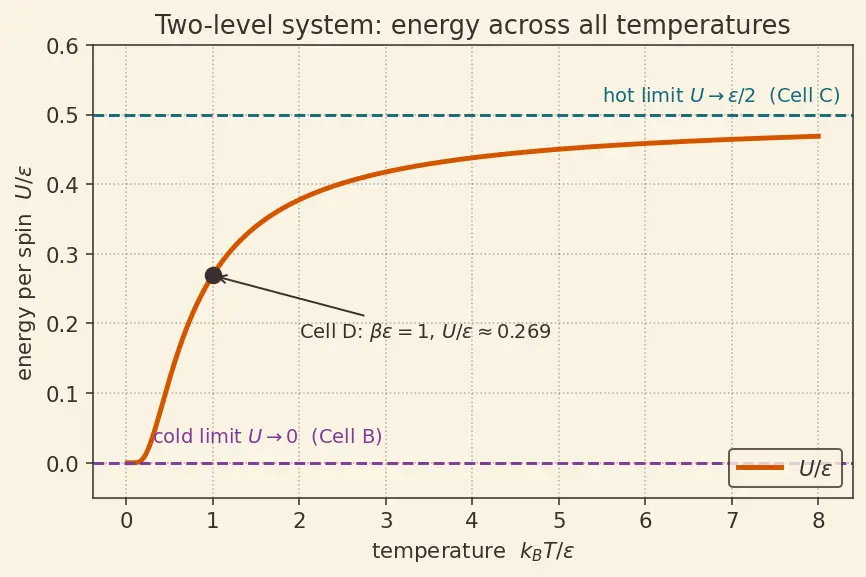
The figure shows the full curve for cell D and marks the two limiting cells B and C on it.
Recall One-line map of every cell
Which examples cover: degenerate, cold, hot, general discrete, continuous, extensive, word-problem, degeneracy, sign? ::: Ex1 (A), Ex2 (B,C,D), Ex3 (E), Ex4 (F), Ex5 (G), Ex6 (H), Ex7 (I) — all nine cells covered.
- Two-level system, excited fraction at βε=1? ::: 1/(e+1)≈0.269.
- 1D free particle U from Gaussian Z? ::: 21kBT (one quadratic DOF, equipartition).
- Why does F scale like N for independent parts? ::: Z=Z1N and ln(Z1N)=NlnZ1 — the log makes F extensive.
- Excited level with degeneracy 3 — high-T population? ::: 3/4, since states are counted by multiplicity when weights →1.
- Correct sign of entropy from F? ::: S=−∂F/∂T (minus built into dF).
