For A=(4623), decide whether A is invertible using the determinant.
Recall Solution 1.1
What we do: compute the determinant of a 2×2 matrix.
detA=(4)(3)−(2)(6)=12−12=0.Why this tool: IMT #13 says invertible ⟺det=0, and for a 2×2 the determinant is the fastest possible check.
Since detA=0, A is NOT invertible. (Notice row 2 =1.5× row 1 — the rows are dependent, consistent with det=0.)
Is A=100020503 invertible? Use the fact that it is triangular.
Recall Solution 1.2
What we do: a triangular matrix (all zeros below the diagonal) has determinant equal to the product of its diagonal entries.
detA=1⋅2⋅3=6=0.Why this tool: IMT #13 again — and for triangular matrices the determinant is just the diagonal product, so no row reduction is needed.
detA=6=0⇒A IS invertible.
A matrix A is 3×5 and its 5 columns are linearly independent. Is A invertible?
Recall Solution 1.3
What we do: check the hypothesis of the IMT before anything else.
The IMT applies only to square matrices. A 3×5 matrix is not square, so the word "invertible" (a two-sided inverse) does not even apply.
Moreover 5 columns cannot be independent in R3 — you cannot fit more than 3 independent vectors into 3-dimensional space (see Basis and Dimension). So the premise is actually impossible.
Answer: NOT invertible — the IMT does not apply to non-square matrices.
Determine invertibility of A=210121012 by computing detA.
Recall Solution 2.1
What we do: expand the 3×3 determinant along the first row.
detA=2det(2112)−1det(1012)+0.
Compute each 2×2: det(2112)=4−1=3, and det(1012)=2−0=2.
detA=2(3)−1(2)+0=6−2=4.Why this tool: cofactor expansion turns a 3×3 into small 2×2's; the zero in position (1,3) makes the last term vanish, saving work.
detA=4=0⇒invertible.
For A=123246134, find a nonzero vector in NulA and use it to decide invertibility.
Recall Solution 2.2
What we do: look for a linear dependence among the columns. The first two columns are (1,2,3) and (2,4,6)=2× column 1.
So column 2−2× column 1=0, i.e. the weights (−2,1,0) combine the columns to zero.
Why this tool: matrix–vector product Ax is a linear combination of columns weighted by x (IMT Link B). A dependence among columns is exactly a null vector.
Check directly with x=(−2,1,0)T:
Ax=−2+2+0−4+4+0−6+6+0=000.✓
A nonzero null vector exists ⇒ IMT #4 fails ⇒NOT invertible.
Use row reduction to decide whether A=(1325) is invertible, and count the pivots.
Recall Solution 2.3
What we do: apply elementary row operations (see Elementary Matrices and Row Reduction).
(1325)R2→R2−3R1(102−1)R2→−R2(1021)R1→R1−2R2(1001)=I.Why this tool: IMT #2/#3 — reaching I with a pivot in every row and column is a direct certificate of invertibility.
Two pivots, RREF =I⇒invertible. Cross-check: det=1⋅5−2⋅3=−1=0.✓
For which real numbers k is A=(1kk4) invertible?
Recall Solution 3.1
What we do: invertibility fails exactly when detA=0, so solve detA=0 and exclude those k.
detA=(1)(4)−(k)(k)=4−k2.Why this tool: IMT #13. Treating the determinant as a function of k turns "invertible?" into a simple equation.
Set 4−k2=0⇒k2=4⇒k=±2.
So A is NOT invertible for k=2 or k=−2, and invertible for all other k, i.e. k∈R∖{−2,2}.
A=11112413t. Find every value of t for which A is singular (not invertible).
Recall Solution 3.2
What we do: compute detA as a function of t, then find its roots.
Expand along the first row:
detA=1det(243t)−1det(113t)+1det(1124).
Each minor: det(243t)=2t−12, det(113t)=t−3, det(1124)=4−2=2.
detA=(2t−12)−(t−3)+2=2t−12−t+3+2=t−7.Why this tool: IMT #13; writing the determinant as the linear expression t−7 makes the singular case obvious.
detA=0⟺t=7. So A is singular exactly when t=7, and invertible for every other t.
Suppose A is 3×3 with eigenvalues 2,−1,0. Is A invertible? What is detA?
Recall Solution 3.3
What we do: use the link between eigenvalues and invertibility (see Eigenvalues and Eigenvectors).
Why this tool: IMT #14 — A is invertible ⟺0 is not an eigenvalue. Here 0is listed as an eigenvalue.
Therefore A is NOT invertible. Confirming via det= product of eigenvalues:
detA=2⋅(−1)⋅0=0,
consistent with IMT #13. A zero eigenvalue λ=0 gives a nonzero x with Ax=0x=0 — a nontrivial null vector, so IMT #4 also fails.
A is n×n and there is a matrix D with AD=I (a right inverse). Prove A is invertible, and hence DA=I too.
Recall Solution 4.1
What we do: show the map x↦Ax is onto, then use squareness to jump to full invertibility.
Step 1 (surjective). For any b∈Rn, set x=Db. Then Ax=A(Db)=(AD)b=Ib=b. So every b has a preimage — the map is onto (IMT #9), equivalently Ax=b solvable for all b (IMT #7).
Why this step:AD=I literally hands us a formula x=Db that solves Ax=b.
Step 2 (climb the IMT). For a square matrix, onto (#9) is in the equivalence loop, so all conditions hold — in particular A is invertible (#1). Invertibility gives a genuine A−1 with A−1A=AA−1=I.
Step 3 (identify D). Multiply AD=I on the left by A−1: A−1AD=A−1⇒D=A−1. Hence DA=A−1A=I. ■Key point: squareness is what lets a one-sided inverse become two-sided (IMT #10, #11).
A and B are n×n and their product AB is invertible. Prove that bothA and B are invertible.
Recall Solution 4.2
What we do: exhibit one-sided inverses for A and for B, then apply Exercise 4.1's principle.
Let M=(AB)−1, so (AB)M=I and M(AB)=I.
B is invertible: from M(AB)=I we read (MA)B=I, a left inverse for B. For square B, IMT #10 ⇒B invertible.
A is invertible: from (AB)M=I we read A(BM)=I, a right inverse for A. For square A, IMT #11 ⇒A invertible.
Why this tool: we never computed inverses; we just found one-sided inverses and let the IMT (via Ex. 4.1) upgrade them. ■
Show that if A is invertible, then AT is invertible, using the determinant.
Recall Solution 4.3
What we do: transfer invertibility across the transpose using two determinant facts.
Fact:det(AT)=detA (transposing does not change the determinant).
Since A invertible ⇒detA=0 (IMT #13), we get det(AT)=detA=0.
By IMT #13 applied to AT, AT is invertible (this is IMT #12). ■Why this tool: the determinant is a single number that "sees through" the transpose, so the whole IMT machinery carries over instantly.
Let A be n×n. Prove directly that "Ax=0 has only x=0" is equivalent to "A has rank n", and interpret geometrically for n=2.
Recall Solution 5.1
What we do: connect null space, pivots and rank (see Rank and Nullity).
(⇒) Suppose Ax=0 forces x=0. Every non-pivot (free) column would create a free variable and hence a nonzero solution; since none exist, there are no free columns. So all n columns are pivot columns ⇒ rank = number of pivots =n.
(⇐) Suppose rank =n. Then there are n pivots, one per column, so there are no free variables. A homogeneous system with no free variables has the unique solution x=0.
Rank–Nullity check:dimNulA=n−rankA=n−n=0, matching "trivial null space" (IMT #17).
Geometry (n=2): the columns of A are two vectors in the plane.
When they are independent (rank 2), they point in different directions and their linear combinations sweep out the whole plane — only the weights (0,0) land on the origin, so the null space is just the origin. When they are dependent (rank 1), both lie on one line; a nonzero combination returns to the origin, giving a nontrivial null vector. ■
Prove: for a square A, "columns span Rn" implies "columns are linearly independent." (This is the surprise the IMT hides — for square matrices spanning forces independence.)
Recall Solution 5.2
What we do: count pivots, using that a square matrix has exactly n rows and n columns.
Spanning ⇒ pivot in every row. If the columns span Rn, the map x↦Ax is onto (IMT #9), which needs a pivot in every row — otherwise some b would be unreachable. That is n pivots (one per row).
n pivots ⇒ pivot in every column. With n pivots spread over n columns, each column holds exactly one pivot; there are no free columns.
No free columns ⇒ independent (IMT #5, via Link B). ■Why it only works for squares: the argument uses "n pivots fill both all rows AND all columns" — possible only when rows = columns. For a 2×3 matrix the columns can span R2 with just 2 pivots, leaving a free column, so they are not independent.
Rank (IMT #15): row 2 =2× row 1, so after R2→R2−2R1 we get (1020) — one pivot, so rank =1<2.
Why three ways: the whole point of the IMT is that these are the same fact; here we watch the single failure appear in three costumes.
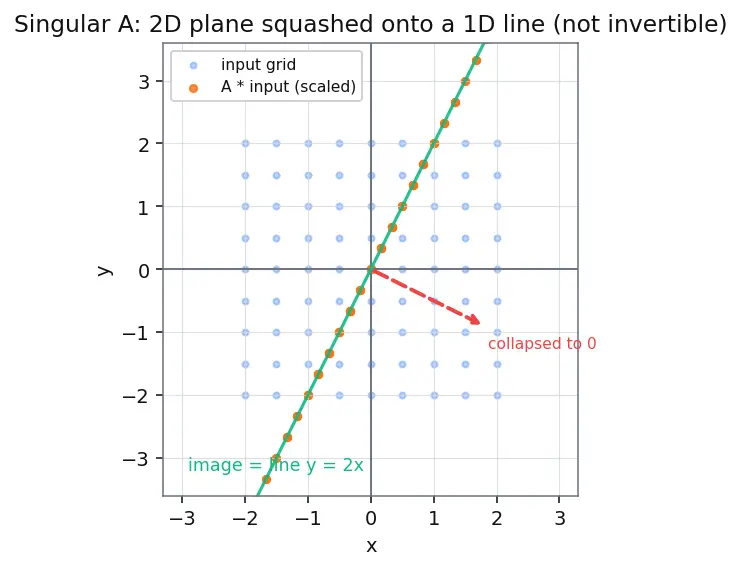
(b) Geometry:
Both columns (1,2) and (2,4) lie on the same liney=2x. Every input vector is mapped onto that one line — the map collapses the 2D plane onto a 1D line. The entire perpendicular direction (2,−1) is squashed to the origin (that's the null vector). A collapse destroys information, so the transformation cannot be undone: not invertible.■
Recall One-sentence summary
Every exercise here reduces to a pivot count — determinant, rank, null space, eigenvalues, spanning and independence are just different lenses on "does A have n pivots?"