Before anything, one reminder of the meaning of each symbol we'll reuse:
Every problem IVT can throw at you falls into one of these cells. The last column names the example that clears it.
| Cell |
Situation |
What makes it tricky |
Example |
| A |
f(a)<0<f(b) (opposite signs) |
the classic Bolzano root |
Ex 1 |
| B |
f(a)>0>f(b) (opposite signs, flipped) |
sign order reversed |
Ex 2 |
| C |
Hit a specific N=0 |
must build g=f−N first |
Ex 3 |
| D |
Same sign at both ends |
IVT is silent — trap |
Ex 4 |
| E |
Endpoint exactly equals N |
is c allowed to be a or b? |
Ex 5 |
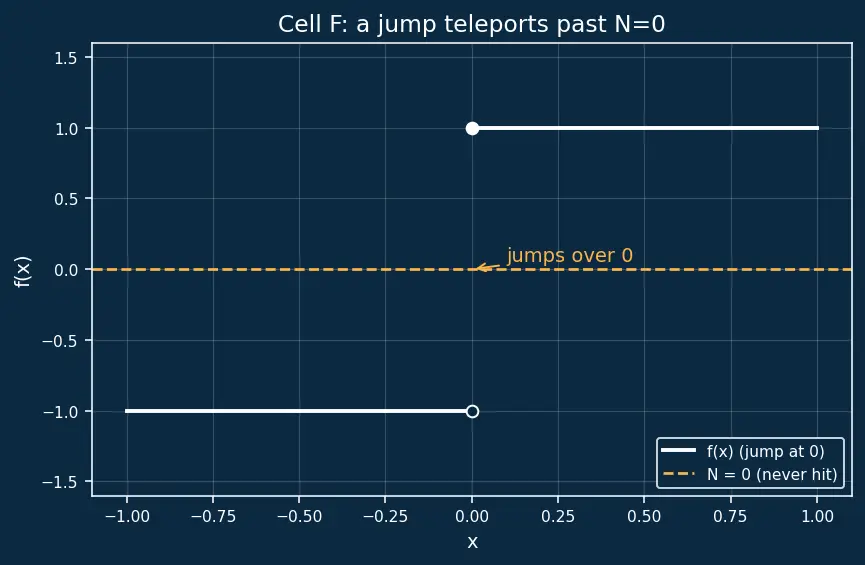
| F |
Discontinuous input |
hypothesis fails — no guarantee |
Ex 6 |
| G |
Degenerate: f(a)=f(b) |
no strictly-between N exists |
Ex 7 |
| H |
Fixed point / self-referential |
turn f(x)=x into a root |
Ex 8 |
| I |
Real-world word problem |
model, then apply |
Ex 9 |
| J |
Exam twist: count / locate |
existence vs uniqueness |
Ex 10 |
| K |
N outside [f(a),f(b)] |
IVT silent (not the same as D) |
Ex 11 |
Skim it, then work down. Each example labels its cell.
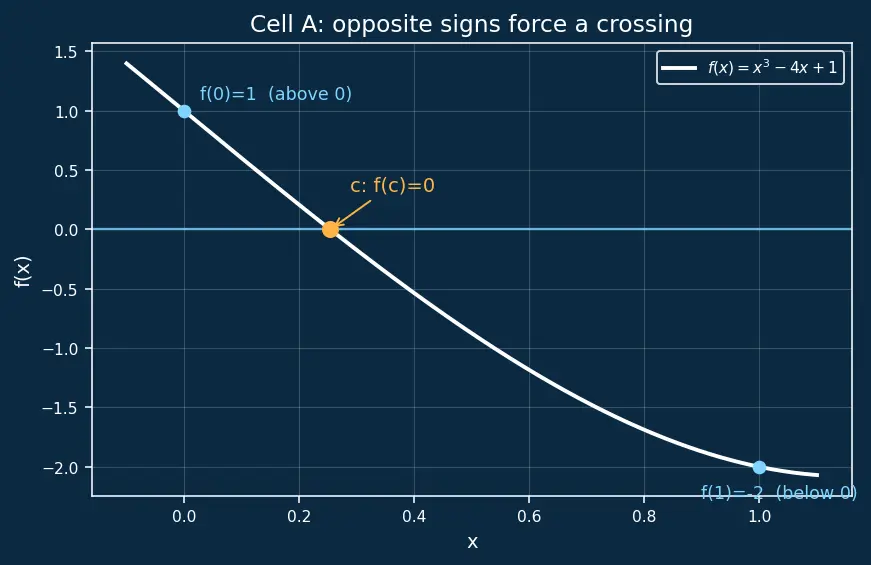
Look at the figure: the white curve dives from height +1 down to −2, and the amber crossing point is the c IVT promises.
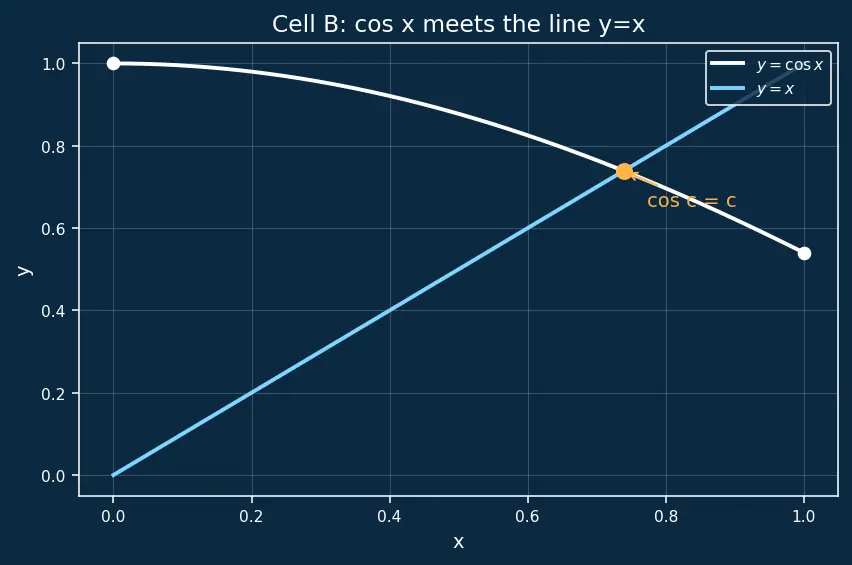
The figure shows the two curves y=cosx and y=x crossing, and equivalently f=cosx−x cutting the axis.
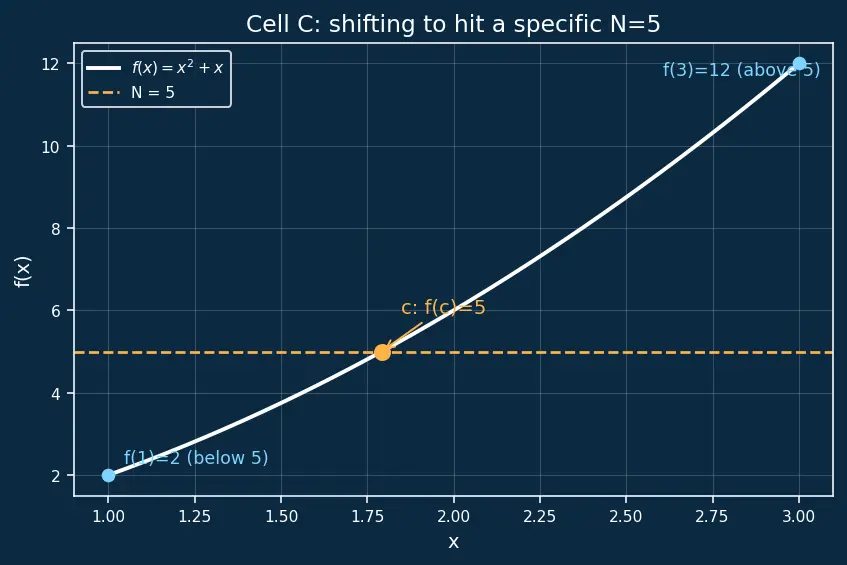
The figure shows f(x)=x2+x climbing across the horizontal target line y=5.
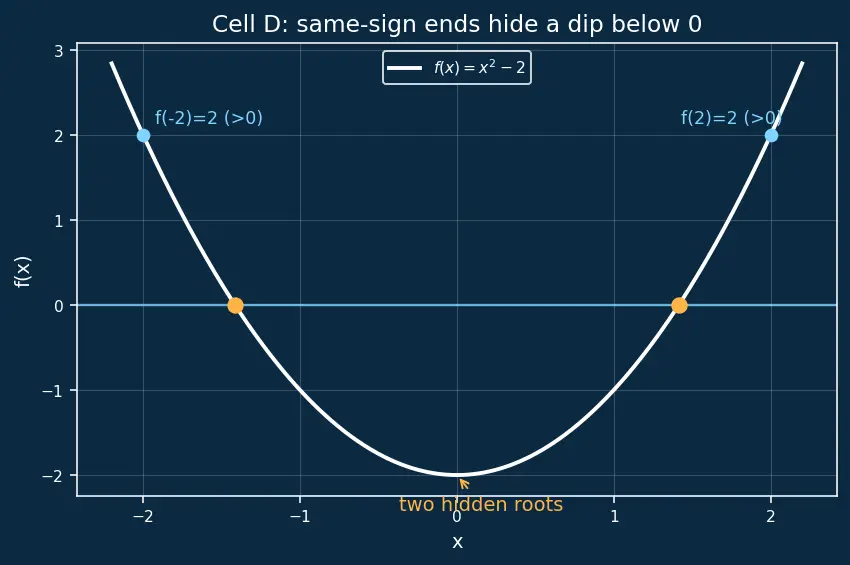
The figure shows the parabola dipping below the axis between two equal, positive endpoints — the dip IVT cannot see.
The figure shows the jump discontinuity leaping over N=0 (dashed line) — no crossing.
- Intermediate Value Theorem — the parent rule these examples exercise.
- Continuity — Cell F fails precisely because this breaks.
- Bolzano's Theorem — the N=0 engine behind Cells A, B, H, J.
- Bisection Method — how to actually locate the c IVT promises.
- Rolle's Theorem and Mean Value Theorem — the tools for counting/uniqueness (Cell J).
- Fixed Point Theorems — Cell H's natural home.


