Exercises — Graphs of logarithmic functions
Throughout, "" means "the power you raise to, to get ". So is exactly the same sentence as . That single equivalence solves almost everything below.
Level 1 — Recognition
These check you can read a log graph's basic features without computation.
Recall Solution L1.1
Answer: (C). Why: The log is the exponential reflected in (see Inverse functions and reflection in y=x). Reflecting swaps every to :
- The exponential's point becomes — so the curve crosses the -axis at .
- The exponential's horizontal asymptote becomes a vertical asymptote .
- means the exponential rises, so its mirror image rises too — but slowly. (A) describes ; (B) describes an exponential, not a log.
Recall Solution L1.2
Domain: . Range: all real numbers. Asymptote: ==== (vertical). Why the domain: , and is always positive, so can never be or negative. Why the range: (the power) can be any real number, positive or negative, so the output covers everything.
Recall Solution L1.3
- because .
- because .
- because . These are the three anchor points , , — they pin the whole curve.
Level 2 — Application
Now compute intercepts and solve simple graph equations by rewriting logs as exponentials.
Recall Solution L2.1
Meeting means equal : set . Why rewrite: a log equation is the same statement as (see Solving equations with logarithms). Intersection point: .
Recall Solution L2.2
Asymptote: the curve has been shifted right 3 (change inside the bracket moves ). So the wall at moves to . Domain: . -intercept (): . Point . A second easy point: gives , i.e. .
Recall Solution L2.3
Rewrite as . Why a negative fractional power: . So . (Notice is still positive, as every log input must be.)
Recall Solution L2.4
on the curve means , always true. So if is on it, the base is . Check: because . ✓
Level 3 — Analysis
Use log laws to rewrite transformed graphs, and reason about slow growth.
Recall Solution L3.1
Split the product using the log law (from Laws of logarithms): Why : it asks "what power of gives ?" → . The sits outside the log of , so it's a vertical shift up 2. A horizontal-looking stretch (multiply inside by ) has become a pure vertical shift — that's the power of log laws.
Recall Solution L3.2
. Comment: to raise from to (just more) the input exploded from to a million. Each extra in costs a ×10 in . This is why logs "compress" huge ranges — the curve rises ever more lazily. See the figure.

Recall Solution L3.3
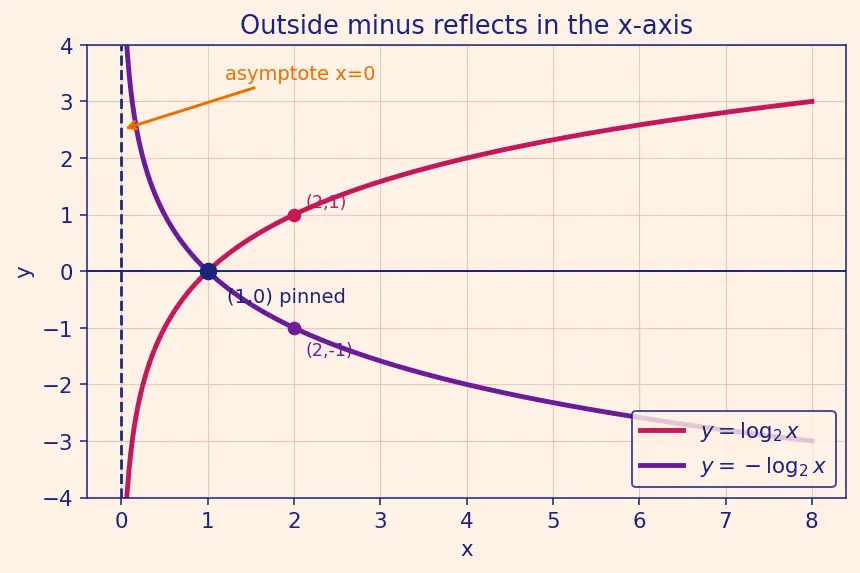
The minus is outside, so it reflects the curve in the -axis (Transformations of graphs). Every flips sign:
- (unchanged — was ).
- .
- .
So is decreasing: it starts at near , falls through , and heads to slowly. Same vertical asymptote , same domain .

Level 4 — Synthesis
Combine several transformations, or work backwards from features to an equation.
Recall Solution L4.1
- Asymptote ⟹ inside change is , so .
- : . ✓ for any base (this just confirms the shift is right).
- : . Equation: . Check : . ✓ Domain: .
Recall Solution L4.2
since (as ). It's shifted up 2. At : . So the point .
Recall Solution L4.3
Yes — identical. Using log laws: . Why this matters: a horizontal-looking rescale (multiply input by ) and a vertical shift (add ) are the same transformation for log graphs. Both pass through and , asymptote .
Recall Solution L4.4
Set equal: . Move the across and write it as a log: , so Why divide inside: subtracting logs = log of a quotient (Laws of logarithms). Rewrite as exponential: . . Then . Check domain: both need ; is fine. Intersection .
Level 5 — Mastery
Full modelling and multi-step reasoning that ties graph, laws, and inverse together.
Recall Solution L5.1
(a) means . (b) . Point . (c) Reflecting a log in undoes the inverse — it gives back the exponential: . (Reflecting swaps and : .)
Recall Solution L5.2
(a) . The reference is the "zero" of the scale.
(b) We want up by : must gain , so gains , meaning is multiplied by . Answer: .
Why: adding to a base- log means multiplying the input by — the slow-growth fact turned into a design rule.
(c) Let . Then : a straight line through the origin with slope . Plotting against the log flattens the exponential range into a line — the whole point of a log scale.

Recall Solution L5.3
Combine with the product law: . Rewrite as exponential: . Domain check: need and , i.e. . So reject (and it would fail anyway). Only survives. Verify: . ✓
Recall Solution L5.4
The exponential () is strictly increasing with no turning point — it just keeps climbing. A reflection in preserves "strictly monotonic" (it only swaps the axes' roles), so is strictly increasing everywhere on . A strictly increasing function has no highest value: for any you pick, is larger. Hence no maximum — it rises without bound, just slowly.
Active recall
Rewrite as an exponential statement.
Inside change moves the graph and asymptote how?
Outside change does what?
equals which vertical shift?
Why must you domain-check solutions of log equations?
Reflecting in gives what?
Adding 1 to a base-10 log input requires multiplying by what?
Connections
- Graphs of logarithmic functions — the parent topic these exercises drill.
- Solving equations with logarithms — the rewrite used throughout.
- Laws of logarithms — product/quotient laws in L3–L5.
- Transformations of graphs — shifts and reflections in L2–L4.
- Inverse functions and reflection in y=x — reflection reasoning in L5.
- Exponential functions and their graphs — the reflection partner.
- Natural logarithm ln and e — the base- special case.