Before we start, the exact symbols we lean on (each earned before use):
The figure below shows all three at a glance — refer back to it whenever a symbol appears.
Mutually exclusive = two events whose circles never touch, so they can't both happen in one trial (A∩B=∅). Overlap = the lens A∩B; the whole drama of the addition rule is whether that lens is empty or not.
Two events can be both mutually exclusive and have probabilities summing above 1.
False — if A∩B=∅ then P(A∪B)=P(A)+P(B), which cannot exceed 1, so P(A)+P(B)≤1 is forced.
If P(A)+P(B)=1, the events must be mutually exclusive.
False — the sum being 1 says nothing about overlap; e.g. P(A)=0.6,P(B)=0.4 could still overlap by 0.3 if P(A∪B)=0.7. The sum-to-1 fact is neither necessary nor sufficient for exclusivity.
False — they're nearly opposite: exclusivity means P(A∩B)=0, but independence needs P(A∩B)=P(A)P(B), which is 0 only if one event has probability zero.
Two events with positive probability that are mutually exclusive are never independent.
True — independence would require P(A)P(B)=P(A∩B)=0, impossible when both probabilities are positive, so knowing A occurred forces B not to (strong dependence).
The general addition rule P(A∪B)=P(A)+P(B)−P(A∩B) only works when events overlap.
False — it always holds; for disjoint events the subtracted term is simply 0, so it collapses to plain adding without any special case.
An event and its complement A′ (everything not in A) are mutually exclusive.
True — no outcome can be both "in A" and "not in A," so A∩A′=∅; they also fill the whole sample spaceS.
If A and B are mutually exclusive, then their complements A′ and B′ are also mutually exclusive.
False — disjoint A,B leave room outside both; those outside outcomes belong to bothA′ and B′, so A′∩B′ is usually non-empty.
Three events being pairwise mutually exclusive means at most one can happen per trial.
True — pairwise disjoint means no two share an outcome, so any single outcome lies in at most one of the three events (possibly none, if it's outside all three).
"P(even OR>3) on a die =63+63=1, so it's certain."
The error is ignoring the overlap {4,6}; correct is 63+63−62=32, since 4 and 6 were counted twice.
"P(A)=0.6, P(B)=0.7, so P(A∪B)=1.3."
A probability can never exceed 1, so this signals the events overlap; the true union is at most 1, and rearranging the general rule gives the overlap P(A∩B)=P(A)+P(B)−P(A∪B)≥0.6+0.7−1=0.3.
"They're both about unrelated events, so mutually exclusive equals independent."
"Unrelated" is a feeling, not a definition; exclusivity is about unions (P(A∩B)=0) while independence is about products (P(A∩B)=P(A)P(B)) — different equations entirely.
"A and B can't both happen, so P(A∩B)=P(A)⋅P(B)."
For exclusive events P(A∩B)=0, not the product; the multiplication rule is for independent events, which is a completely different situation.
"For any two events, P(A∪B)=P(A)+P(B)."
This drops the overlap term without checking; it's only valid after confirming A∩B=∅, otherwise you double-count shared outcomes.
"Since A∩B=∅, I'll subtract P(A∩B) to be safe — but I estimated it as 0.1."
If they're truly disjoint the overlap is exactly 0, so guessing 0.1 invents an overlap that isn't there and gives a wrong, smaller answer.
"Drawing a King or a Queen — a card could be both, so subtract the overlap."
No single card is simultaneously a King and a Queen, so the events are exclusive and the overlap is 0; plain adding 524+524 is correct.
Why do we subtract the overlap in the general rule instead of adding it?
When we compute P(A)+P(B), every outcome in the lens A∩B is counted once for A and once for B — twice total — so subtracting it once restores an honest single count.
Why does mutual exclusivity make the subtraction term vanish rather than the whole rule change?
The rule never changes; exclusivity just sets A∩B=∅ so P(A∩B)=0, meaning there is literally nothing double-counted to remove.
Why can't two positive-probability mutually exclusive events be independent, intuitively?
If A happening forbidsB, then learning A occurred changes B's chance to 0 — that's a huge amount of information, the opposite of "tells you nothing," which independence demands.
Why is the complement rule P(A′)=1−P(A) really just the addition rule in disguise?
A and A′ are exclusive and together fill S, so P(A)+P(A′)=P(S)=1, which rearranges directly to P(A′)=1−P(A).
Why is "OR means add" a dangerous default rather than a safe one?
It quietly assumes no overlap, which is true in tidy single-die examples but false the moment events can co-occur, silently inflating your answer.
Why does the addition rule extend to ∑iP(Ai) for many events only when they're pairwise disjoint?
Pairwise disjointness guarantees no outcome is shared by any two events, so no outcome is ever counted more than once when you add all the pieces.
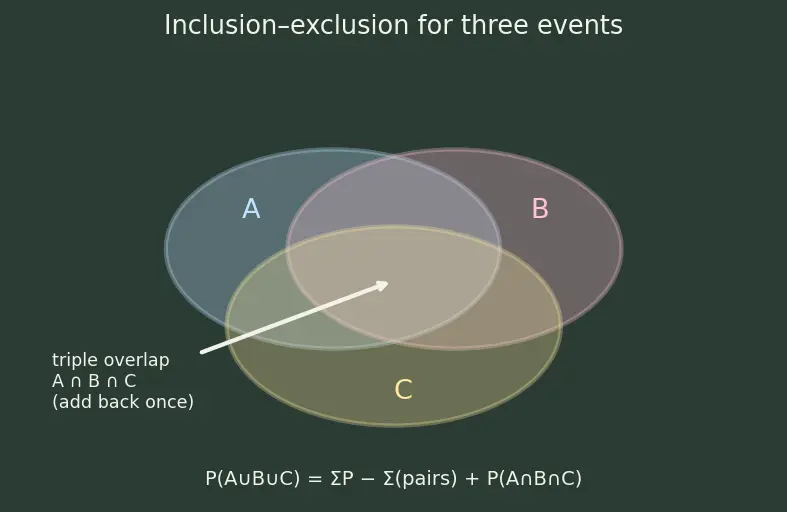
Why does inclusion–exclusion for three overlapping events add back a term after subtracting?
You first subtract each pairwise overlap, but an outcome in all three (A∩B∩C) gets subtracted one time too many, so P(A∪B∪C)=P(A)+P(B)+P(C)−P(A∩B)−P(A∩C)−P(B∩C)+P(A∩B∩C) adds that triple lens back once — see the figure below.
If B=∅ (impossible event), are A and B mutually exclusive?
Yes — the empty set shares no outcome with anything, so A∩B=∅ trivially, and P(A∪B)=P(A)+0=P(A) as expected.
If A⊆B (every outcome of A is in B), can they be mutually exclusive?
Only if A=∅; otherwise A's outcomes lie inside B, so A∩B=A=∅ and they overlap completely.
Can an event be mutually exclusive with itself?
Only the impossible event ∅, since A∩A=A, which is empty exactly when A itself is empty.
If P(A)=0, is A mutually exclusive with every other event?
Set-theoretically not necessarily — A can still share outcomes with B, so A∩B need not be empty. But probabilistically: since A∩B⊆A, we get P(A∩B)≤P(A)=0, forcing P(A∩B)=0; hence P(A∪B)=P(A)+P(B)−0=P(B), so Aadds like an exclusive event even though the sets may overlap. The lesson: "disjoint sets" and "zero-overlap probability" are different claims, and here only the second holds.
For exhaustive mutually exclusive events (a partition), what must their probabilities sum to?
Exactly 1, because disjoint pieces covering the whole sample space add without overlap to P(S)=1.
If two events cover the sample space but overlap, do their probabilities still sum to 1?
No — they sum to more than 1 by exactly the overlap P(A∩B), since P(A)+P(B)=P(A∪B)+P(A∩B)=1+P(A∩B).
Is it possible for three events to be pairwise mutually exclusive yet their union not cover S?
Yes — disjointness only forbids overlap, it says nothing about coverage; outcomes outside all three simply belong to none of them.