Every problem this topic throws lives in exactly one of these cells. We will hit all of them.
| Cell |
Connective |
Situation |
What the answer looks like |
| C1 |
AND |
two rays that do overlap (point toward each other) |
a single bounded interval [a,b) etc. |
| C2 |
AND |
two rays pointing apart |
∅ (no solution) |
| C3 |
AND |
boundaries touch at one point (degenerate) |
a single point {c} |
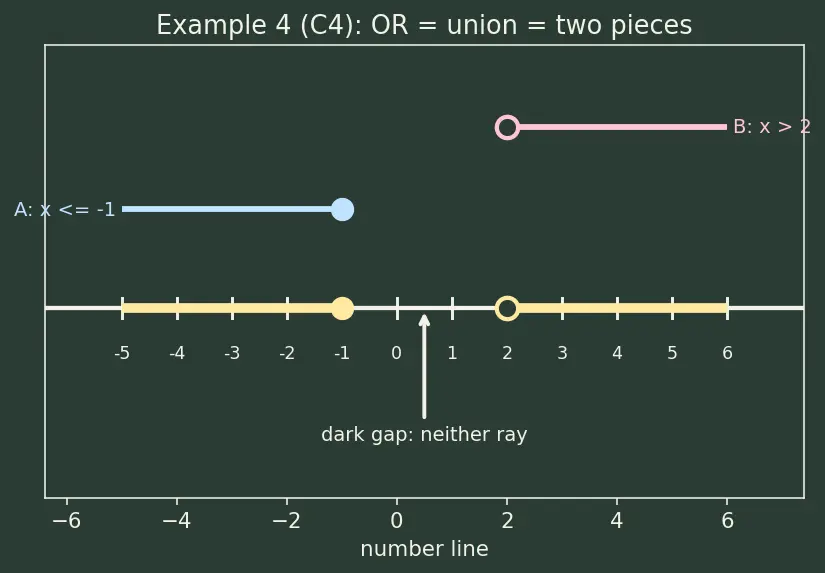
| C4 |
OR |
two disjoint rays |
two pieces (−∞,a)∪(b,∞) |
| C5 |
OR |
rays point toward each other and overlap → flood |
all reals R |
| C5b |
OR / AND |
same-direction (nested) rays → one unbounded ray |
(a,∞) or (−∞,a) |
| C6 |
AND |
three-part a<f(x)<b, positive coefficient |
single interval |
| C7 |
AND |
three-part, divide by a negative (flip both) |
single interval, order reversed |
| C8 |
AND |
real-world word problem |
interval + units |
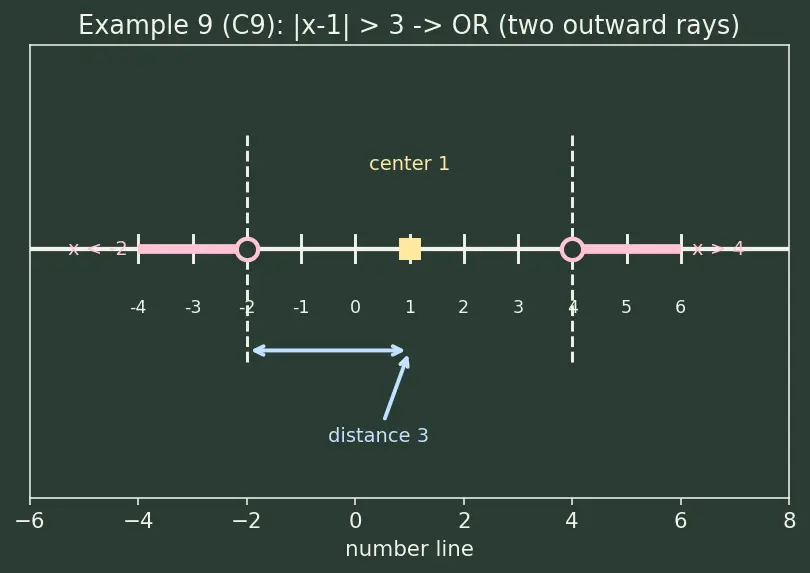
| C9 |
OR |
exam twist — hidden absolute value $ |
x |
| C10 |
AND |
exam twist — hidden absolute value $ |
x |
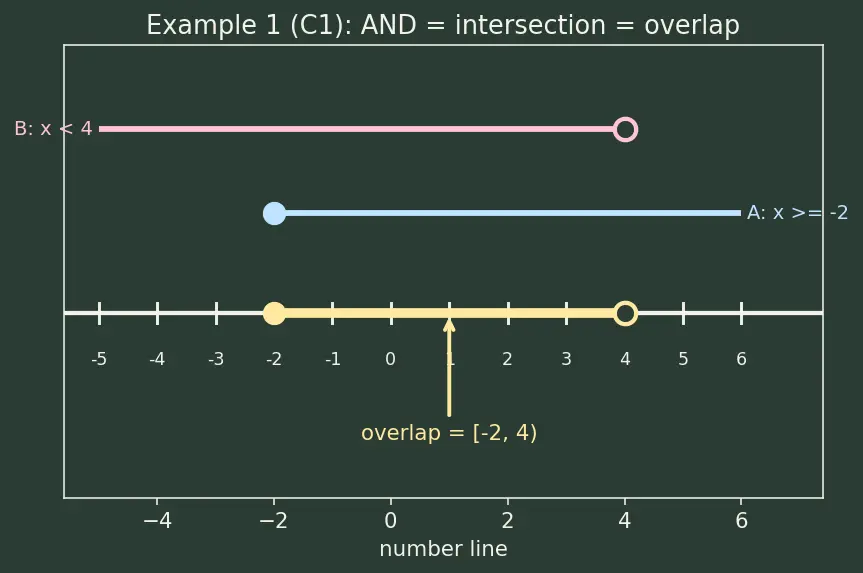
Which set operation gives the narrow overlap?
Intersection ∩ (the AND case).
What does ∞ mean and why does it always take a round bracket?
It means "goes on forever, no end"; it's not a reachable number, so the endpoint can never be included.
What does R stand for?
The real numbers — every number on the whole line at once.
∣x∣<k becomes which kind of compound inequality?
An AND — the single interval −k<x<k.
∣x∣>k becomes which kind of compound inequality?
An OR — two rays x<−k or x>k.
Solve x≥3 AND x≤3.
The single point {3}.
Solve x≤−1 OR x>2.
(−∞,−1]∪(2,∞).
Why does x>−3 OR x<7 equal all reals?
The rays point toward each other and overlap, so no number can fail both — the union floods R.
Solve x>1 OR x>3.
(1,∞) — the bigger ray swallows the smaller.
Solve x>1 AND x>3.
(3,∞) — the stricter bound wins.
Dividing a three-part inequality by −3 does what?
Flips BOTH relation signs at once.


