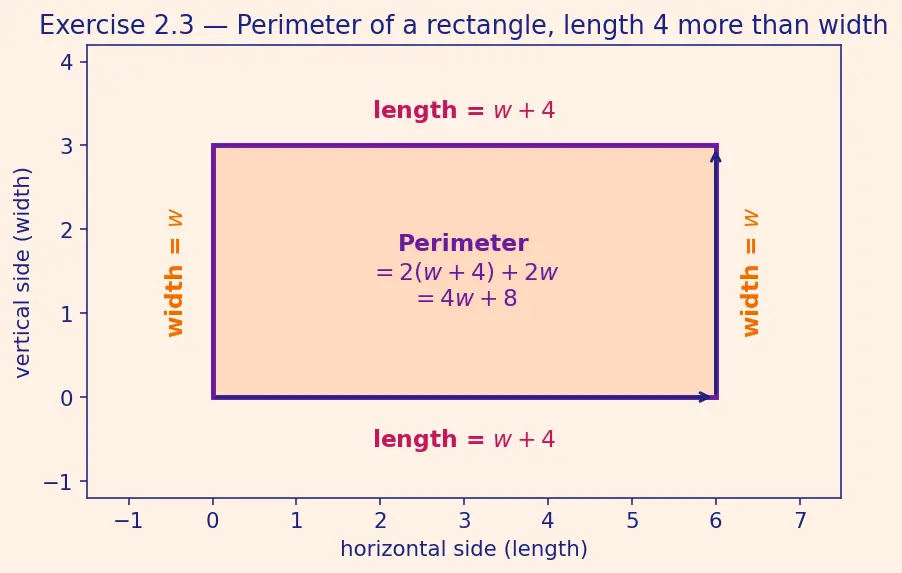
A rectangle has width w and length that is 4 more than the width. Write an expression for the perimeter (perimeter = twice the length + twice the width).
Recall Solution 2.3
Length =w+4 (four more than the width).
Perimeter =2(length)+2(width)=2(w+4)+2w.
Open the bracket: 2(w+4)=2w+8.
So perimeter =2w+8+2w=4w+8.
4w+8
Coefficient of w is 4; constant term is 8.
For 6x2y−4xy+y−11 list, term by term, the variables, the coefficient, and the degree (degree = sum of the powers of all variables in that term).
Recall Solution 3.1
Term
Variables
Coefficient
Degree
6x2y
x,y
6
2+1=3
−4xy
x,y
−4
1+1=2
y
y
1
1
−11
none
−11
0
Notes: the coefficient of the lone y is the invisible 1; the constant −11 has degree 0 because it can be seen as −11⋅x0 (any variable to the power 0 equals 1).
Two students simplify 5x−x+2−2. Amir writes 4x; Bela writes 4x+0; Carl writes 5x−x=4x and "the constants vanish." Are all three answers correct? Explain what each is really claiming.
Recall Solution 3.3
5x−x=5x−1x=4x (remember x=1x).
2−2=0.
So the expression equals 4x+0=4x.
Amir (4x) and Bela (4x+0) are the same value — writing "+0" is legal but redundant.
Carl is also correct: the constants really do cancel to 0, so they "vanish."
4x
A taxi charges a fixed ₹50 booking fee plus ₹18 per kilometre. Then a flat ₹20 discount is applied. Write a simplified expression for the fare after d kilometres, and identify the coefficient of d and the constant term.
Recall Solution 4.1
Distance cost: 18d.
Add the booking fee: 18d+50.
Apply the discount (subtract 20): 18d+50−20.
Combine constants: 50−20=30.
18d+30
Coefficient of d: 18. Constant term: 30. (Check at d=10: 18(10)+30=210.)
Design an expression in one variable x that satisfies all of these: it has exactly three terms; the coefficient of x2 is −2; the coefficient of x is the invisible 1; and the constant term is 21. Then state its value when x=2.
Recall Solution 4.3
Coefficient of x2 is −2 → term −2x2.
Coefficient of x is 1 (invisible) → term x.
Constant term 21 → term +21.
−2x2+x+21
Value at x=2: −2(4)+2+21=−8+2+0.5=−5.5.
Is x2+x1 a "constant + variable-with-coefficient" style expression like the others on this page? Identify each term's coefficient and power, and explain what is unusual.
Recall Solution 5.1
Rewrite x1=x−1.
Terms: x2 (coefficient 1, power 2) and x−1 (coefficient 1, power −1).
Unusual: the second term has a negative power — the variable sits in a denominator. It is still an algebraic expression, but it is not a polynomial (polynomials allow only whole-number powers 0,1,2,…). See Polynomials.
There is no constant term here (no term of power 0).
A student claims: "In 5x, if I let x vary then 5 is really varying too, because 5x changes." Steel-man this, then decisively refute it.
Recall Solution 5.2
The strongest version of the claim: the product5x does change as x changes — at x=1 it's 5, at x=3 it's 15 — so "something on the left is moving."
Refutation: yes, the value of the whole term5x changes, but that change comes entirely from x. The factor 5 is fixed: every time we multiply by exactly 5, never 4.9 or 6. Test it: pick any two values of x and divide the results, 515=3=x1x2 — the ratio is governed by x, and 5 cancels out because it is constant.
Conclusion:5 is the coefficient (fixed), x is the variable (changing). A moving output does not make every factor a variable.
Two expressions are given: E1=3x+3x and E2=3x2. A classmate says "both are just 3 copies of something, so they're the same." Explain, using coefficients and powers, why E1=E2, and give the correct simplification of each. Verify at x=4.
Recall Solution 5.3
E1=3x+3x is adding two like terms: 3x+3x=6x (coefficient 6, power 1).
E2=3x2 is multiplyingx by itself once, then scaling by 3 (coefficient 3, power 2).
"3 copies of something" describes E1 (three-ish times x, twice), but E2 is xsquared — a different operation entirely (power, not repeated addition).
Check at x=4:E1=6(4)=24; E2=3(16)=48. Different numbers → different expressions.
E1=6x,E2=3x2
Recall Quick self-check (cloze)
The coefficient of x in the term −x is ==−1==.
A symbol with a permanently fixed value, like π, is a constant.
The degree of the term 6x2y is ==3== (sum of the powers 2+1).
Simplifying 3x+3x gives ==6x==, while 3x2 stays ==3x2 — addition raises the coefficient, powers raise the exponent==.