Exercises — Hydrides — ionic, covalent, interstitial
Before we start, here is the one energy tool we reuse everywhere.
The picture below is that same sum drawn as a staircase — each positive step climbs, the big lattice step plunges below the start, and where you land is . We will refer back to it in L3.

L1 — Recognition
Problem 1.1 (L1)
Classify each hydride as ionic, covalent, or interstitial: , , , , , .
Recall Solution 1.1
Rule of thumb — look at the partner of hydrogen. (A quick vocabulary note first: the periodic table splits into blocks by which orbital the outermost electrons fill. Group 1 & 2 metals are the "s-block". The middle rectangle — the "transition metals" like Ti, Pd, Fe — is the "d-block" because their d-orbitals are filling; you don't need any orbital detail here, just recognise them as the metals in the central block.)
- → Ca is a Group 2 metal (not Be) → ionic (contains ).
- → C is a non-metal, similar electronegativity to H → covalent.
- → Ti is a transition metal (from the central d-block), and the formula is non-stoichiometric (1.8, not a whole number) → interstitial.
- → F is a non-metal → covalent.
- → K is a Group 1 metal → ionic.
- → Pd is a transition (d-block) metal, fractional formula → interstitial.
Problem 1.2 (L1)
State the electronic configuration of the hydride ion and name the noble gas it is isoelectronic with.
Recall Solution 1.2
Neutral H has configuration . Adding one electron gives with — the same two-electron closed shell as helium (He). "Isoelectronic" just means "same number of electrons": both have 2.
L2 — Application
Problem 2.1 (L2)
Complete and balance the reaction of calcium hydride with water, and state one everyday use that follows from it.
Recall Solution 2.1
is a strong base; it strips a proton from water to make : Balance check (count each element on both sides):
- Ca: left has 1 (in ); right has 1 (in ). ✓
- O: left has 2 (from ); right has 2 (the two O in ). ✓
- H — left side: 2 H from , plus H from → total 6.
- H — right side: has 2 H (one H in each of its two OH groups), plus has H → total 6. ✓
Six H on each side, so the equation is balanced. Use: because it consumes water and releases , is a portable drying agent and a field source of hydrogen gas (weather balloons).
Problem 2.2 (L2)
Given the H–H bond energy is , what is , the cost of making one gaseous H atom from ?
Recall Solution 2.2
Splitting one whole molecule into two H atoms costs . We only want one atom (from half a molecule): This is the term you plug into the Born–Haber sum.
L3 — Analysis
Problem 3.1 (L3)
Using the master sum, compute for from these values (kJ/mol): sublimation of Na ; ; ; ; lattice energy . Is formation favourable?
Recall Solution 3.1
Add every term straight down the master sum (follow the staircase figure at the top of the page — each number is one step): Step by step: ; ; ; . Negative → favourable (exothermic). Notice the single term that rescues it: the lattice energy (the big downward plunge in the figure) is bigger in magnitude than the whole positive pile (). Ionic hydrides only exist because packs efficiently and releases huge lattice energy.
Problem 3.2 (L3)
boils at but (heavier, vs ) boils at . Explain the reversal, and estimate how many times more energy per mole H₂O needs to vaporize than H₂S given and .
Recall Solution 3.2
Reasoning: By mass alone, heavier should boil higher (more electrons → stronger dispersion forces). It doesn't — so a stronger force must be at work in water. Oxygen is small and very electronegative ( vs S at ), so the O–H bond is strongly polar and each molecule forms hydrogen bonds ( each) to neighbours. S is larger, less electronegative → negligible H-bonding, only weak dispersion. Breaking the H-bond network in water needs far more heat → higher boiling point. Ratio: Water needs about 2.2× the vaporization energy — consistent with the extra hydrogen-bond cost.
L4 — Synthesis
Problem 4.1 (L4)
Beryllium is a Group 2 metal, yet is not ionic. Build the argument from energy and from Fajans' rules. Data (kJ/mol): sublimation Be ; ; lattice energy of hypothetical ionic ; plus (two H atoms) (two electron affinities).
Recall Solution 4.1
Energy test. For an ionic we would need: Compute: ; ; ; . The huge double ionization () is not paid back even by a big lattice energy. Contrast with Na (Problem 3.1) where only one modest ionization () had to be covered. Fajans' reasoning. is tiny with charge → enormous charge density → it strongly polarizes (distorts) the electron cloud, dragging electron density into the bond region. That is exactly what a covalent bond is. Result: is a polymeric, electron-deficient, covalent solid (bridging 3-centre-2-electron B-like bonds), not a salt.
Problem 4.2 (L4)
does not exist as a stable molecule; instead we get diborane . Using an electron count, show why, and state how many electrons the two bridge bonds share.
Recall Solution 4.2
Electron count for : B contributes 3 valence electrons; three B–H bonds need electrons but B only supplies 3 and the three H's supply 3 → exactly 6, so all three bonds form — but boron is left with an empty p orbital (only 6 electrons around B, not the octet's 8). "Electron-deficient" → very reactive → it grabs a partner.
Dimerization: two units join into .
Read the figure below carefully: the two black borons in the centre are joined only through the red bridging H atoms — there is no line drawn directly between the borons, because there is no B–B bond. Follow the black lines out to the four terminal H atoms (ordinary 2-centre-2-electron bonds), then look at how each red bridge H connects to both borons at once. That double connection is the picture of a 3-centre-2-electron bond: one electron pair smeared across three atoms.

L5 — Mastery
Problem 5.1 (L5)
A titanium hydride sample has formula . (a) Explain why the subscript is not a whole number. (b) If you have of Ti fully loaded to , how many moles of gas were absorbed? (c) Why does this make interstitial hydrides useful for hydrogen storage?
Recall Solution 5.1
(a) Interstitial hydrides are non-stoichiometric: H atoms slot into the gaps (interstitial sites) between the metal atoms in the crystal lattice — see the interstitial-site figure below, where the red H atom sits in a hole between four black metal atoms. Not every gap need be filled, and the filling depends on temperature and pressure — so the H:Ti ratio is a continuous variable, not a fixed integer. This is impossible for ionic/covalent hydrides where whole-number valence rules apply.

Problem 5.2 (L5)
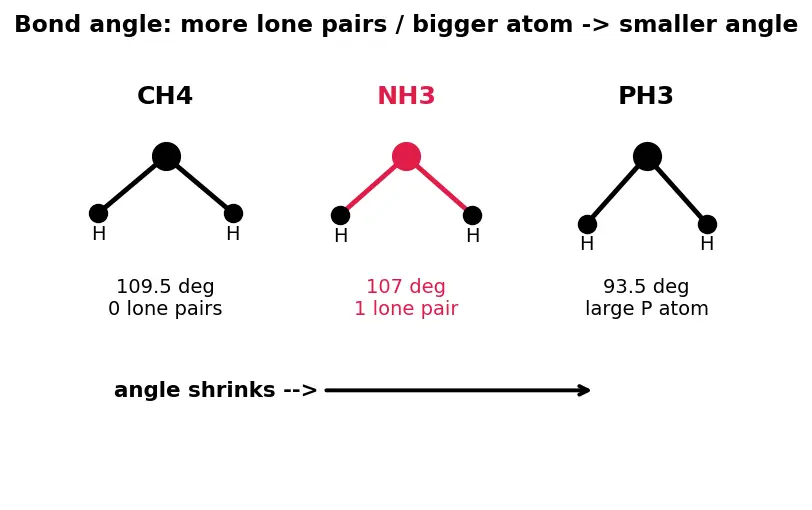
Rank , , and by H–X–H bond angle, largest first, and justify each value (, , available) using lone pairs and central-atom size.
Recall Solution 5.2
Ranking: . How to read the figure below: three molecules side by side, each drawn as a central atom with two H bonds so you can see the angle between them. The middle one, , is highlighted in red because it is the pivotal case — one lone pair pushing the angle down from the perfect tetrahedral value. Trace how the "V" of the two bonds gets narrower as you move left→right: wide for , a little tighter for , sharply pinched for .
- : carbon has 4 bonding pairs, 0 lone pairs → perfect tetrahedron → .
- : nitrogen has 3 bonds + 1 lone pair. A lone pair takes more angular room and squeezes the bonds together, dropping the angle to .
- : phosphorus is in the same group as N but much larger. The big P atom holds the H's far apart, orbital overlap is poor, and the bonds sit almost at (pure p-orbitals) → .
Rule captured: more lone pairs and larger central atoms both shrink the bond angle.

Self-test recap — how to use it
Recall Self-test prompts (reveal after answering aloud)
An ionic hydride example, and what ion it contains (Problem 1.1) ::: NaH / KH / CaH₂ (Group 1 & 2 except Be); contains the hydride ion H⁻ The single energy term that makes ionic-hydride formation exothermic (Problem 3.1) ::: the large negative lattice energy — it outweighs the whole positive pile of sublimation + ionization + bond-splitting Why has a fractional formula (Problem 5.1) ::: interstitial hydrides are non-stoichiometric — H atoms fill lattice gaps, and how many gaps fill depends on temperature/pressure Name and electron count of the bridge bonds in (Problem 4.2) ::: 3-centre-2-electron (3c-2e) bonds — one electron pair shared across B–H–B; two bridges = 4 bridging electrons, no B–B bond Why boils far above despite being lighter (Problem 3.2) ::: hydrogen bonding in water (O is small and very electronegative), which is absent in the larger, less electronegative H₂S Why is covalent, not ionic (Problem 4.1) ::: forming Be²⁺ costs too much (double ionization 2657 kJ/mol) and tiny high-charge Be²⁺ polarizes H⁻ (Fajans' rules) → covalent character