4.5.12 · D3 · Maths › Linear Algebra (Full) › Rank of a matrix — definition, row rank = column rank theore
Kisi bhi computation se pehle, ek reminder plain words mein.
Har matrix in "cells" mein se kisi ek mein aati hai. Humara kaam hai sabko ek worked example se cover karna.
| Cell |
Case class |
Kya cheez tricky banati hai |
Example |
| A |
Square, full rank (r=n) |
har direction survive karta hai |
Ex 1 |
| B |
Square, rank-deficient (r<n) |
ek hidden dependency |
Ex 2 |
| C |
Wide rectangle m<n |
columns zyada hain space se |
Ex 3 |
| D |
Tall rectangle m>n |
rank columns se cap hota hai |
Ex 4 |
| E |
Zero rows / zero columns present |
nonzero-row trap |
Ex 5 |
| F |
All-zero (degenerate) matrix |
limiting case r=0 |
Ex 6 |
| G |
Rank-1 witness (outer product) |
column rank instantly dikh jaata hai |
Ex 7 |
| H |
Real-world word problem (data table) |
translate karo phir rank nikalo |
Ex 8 |
| I |
Exam twist — rank of a product AB |
bound rank(AB)≤min |
Ex 9 |
| J |
Parameter case — rank ek symbol k par depend karta hai |
limiting/degenerate values |
Ex 10 |
Ab hum har cell chalte hain.
Worked example Ex 6 · Zero matrix ki rank kya hoti hai?
A=(0000)
Forecast: koi bhi independent direction nahi hai — machine har vector ko origin par bhejti hai. Predict karo rank=0.
Step 1 — reduce karo. Kuch karne ki zaroorat nahi; yeh already echelon form mein hai.
Step 2 — pivots count karo. Kahin bhi koi non-zero entry nahi hai ⇒ zero pivots. rank=0.
Yeh legal kyun hai? Bound 0≤rank(A)≤min(m,n) explicitly 0 allow karta hai. Yeh lower limiting value hai.
Verify: row space ={0} ki dimension 0 hai; column space ={0} ki dimension 0 hai. Dono 0 ke equal hain. Theorem extreme par bhi survive karta hai. ✔️
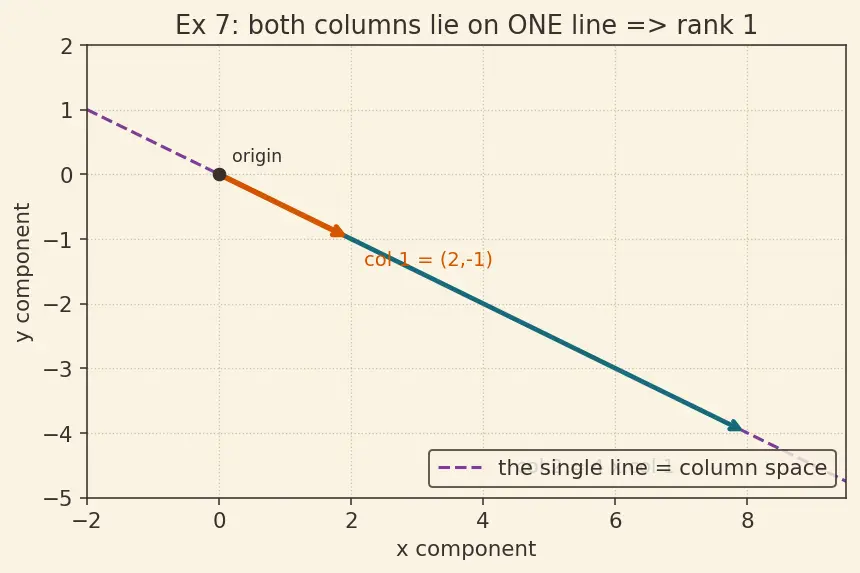
Worked example Ex 7 · Column rank instantly dekho
A=2−13(14)=2−138−412
Forecast: A ek single column times ek single row hai. Har column (2,−1,3)T ka scalar multiple hai. Toh column rank =1. Predict karo rank=1.
Step 1 — confirm karo ki columns proportional hain. col2=4⋅col1.
Kyun? Matrix Multiplication as Linear Combination: ek outer product uvT mein har column u ka multiple hota hai, toh uska column space u se guzarni ek single line hai.
Step 2 — column space ek line hai (2,−1,3) se guzarti ⇒ dimension 1 ⇒ rank=1.
Verify: reduce karke check karo. R2→R2+21R1, R3→R3−23R1 dono apni rows ko khatam karte hain, ek pivot bacha. Row rank =1= column rank. ✔️
Worked example Ex 8 · Ek price table jo utni informative nahi jitni lagti hai
Ek shop teen receipts record karta hai. Har row hai (\text{apples},\ \text{bananas},\ \text{total cost in }\)$:
A=2411235108
Question: yahan kitne genuinely independent pricing information ke pieces hain?
Forecast: receipt 2 exactly double hai receipt 1 ke (wahi shopping, do baar) — yeh kuch naya nahi sikhata. Toh 3 receipts mein se, sirf 2 independent facts expect karo. Predict karo rank=2.
Step 1 — translate karo. "Independent pieces of information" = receipt table ka rank.
Kyun? Har dependent row redundant data hai; rank non-redundant wale count karta hai.
Step 2 — reduce karo. R2→R2−2R1, R3→R3−21R1.
→200102550211
Step 3 — zero row neeche swap karo. R2↔R3.
→200125052110
Step 4 — pivots count karo: (1,1) aur (2,2) ⇒ do. rank=2.
Verify (units & meaning): column 3 ki entries dollars hain, columns 1–2 counts hain — numbers consistent rehte hain, aur answer "2 independent receipts" us observation se match karta hai ki receipt 2 ne receipt 1 ko duplicate kiya. Shop ke paas effectively 2 pricing equations hain, do unknown prices solve karne ke liye kaafi. ✔️
Worked example Ex 9 · Multiply karne se pehle
rank(AB) predict karo
A=(1224),B=(111111)
Forecast: A ka rank 1 hai (row 2 =2×row 1) aur B ka rank 1 hai (row 2 = row 1). Bound kehta hai rank(AB)≤min(rankA,rankB)=min(1,1)=1. Predict karo rank(AB)≤1.
Step 1 — multiply karo.
Kyun? Dekhne ke liye ki bound equality se meet hota hai ya product aur collapse hota hai (woh bound se neeche jaa sakta hai).
AB=(1⋅1+2⋅12⋅1+4⋅1⋯⋯⋯⋯)=(363636)
Step 2 — result ka rank. Har column (3,6)T hai; row 2 =2×row 1. Reduce karne ke baad ek pivot. rank(AB)=1.
Verify: 1≤min(1,1)=1 ✔️ — bound hold karta hai aur yahan tight bhi hai.
Recall Product bound se neeche kyun jaa sakta hai
Wahi A lo lekin B′=(1−2100) (rank 1). Toh AB′ ke columns A ke kernel mein jaa sakte hain aur rank(AB′)=0 de sakte hain. Bound ek upper limit hai, equality ki guarantee nahi.
Worked example Ex 10 · Rank kab drop karta hai?
A=(132k)
ek real number k ke liye. Har case mein rank(A) nikalo.
Forecast: do rows hain. Woh dependent tab bante hain jab row 2 row 1 ka multiple ho. Row 1 hai (1,2); 3 se scale karke (3,6) milta hai. Toh danger value hai k=6. Predict karo: generally rank 2, k=6 par rank 1.
Step 1 — eliminate karo. R2→R2−3R1.
Kyun? Uss single entry ko isolate karo jiska vanish hona dependence signal karta hai.
→(102k−6)
Step 2 — pivot entry k−6 par split karo.
- Agar k−6=0 (yaani k=6): doosra pivot exist karta hai ⇒ rank=2.
- Agar k−6=0 (yaani k=6): row 2 vanish ho jaati hai ⇒ sirf ek pivot ⇒ rank=1.
Dono kyun cover karein? Parent contract: har case, including degenerate/limiting value k=6, dikhana zaroori hai.
Verify: detA=1⋅k−2⋅3=k−6. Full rank ⟺det=0⟺k=6. k=6 par, det=0 aur rank 1 par drop karta hai. Pivot analysis se consistent. ✔️
Recall Scenario matrix par quick self-check
Kaunse cell mein rank=0 hai, aur yeh allowed kyun hai? ::: Cell F (all-zero matrix); bound 0≤rank≤min(m,n) lower limit 0 allow karta hai.
Ek wide 2×5 matrix — uski maximum possible rank kya hai? ::: min(2,5)=2.
Agar rankA=1 aur rankB=1, toh kya rank(AB)=0 ho sakta hai? ::: Haan — bound sirf ek upper limit hai; A ke kernel ke saath overlap use aur neeche push kar sakta hai.